
Modern data centers operate under tight margins for error. As a result, even short disruptions can cascade into service outages, data loss, or contractual penalties. To address these risks, advanced data center infrastructure monitoring provides continuous, measurable insight into how physical and digital components behave under real operating conditions.
By observing power stability, thermal behavior, network load and system health in parallel, organizations gain the ability to detect early warning signs rather than reacting to failures after they happen. This level of visibility allows operations teams to intervene when deviations are still manageable, protecting service continuity and maintaining predictable performance.
Beyond failure prevention, end-to-end visibility connects infrastructure behavior directly to business services. Instead of isolated metrics, monitoring data shows how changes in cooling, power, or capacity affect application performance and user experience. This alignment elevates advanced data center monitoring from a passive reporting layer to an active operational decision‑making tool that directly supports informed and timely actions.
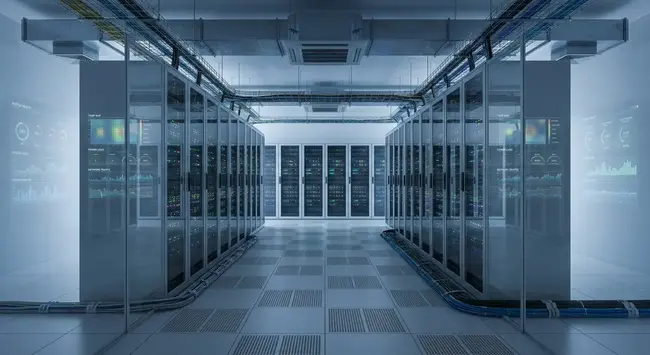
A successful monitoring strategy starts with an honest assessment of the current environment. Many data centers rely on fragmented tools that focus on a single domain, such as network traffic or server performance, while ignoring power distribution or environmental conditions. These gaps reduce situational awareness and slow down troubleshooting.
During evaluation, hardware age, sensor coverage, data accuracy and system interoperability must be reviewed. Equally important is identifying blind spots where failures could occur without triggering alerts. This phase establishes a clear baseline and prevents the deployment of monitoring solutions that replicate existing weaknesses rather than resolving them.
Monitoring objectives should be derived from business priorities, not tool capabilities. For example, facilities supporting financial systems require tighter thresholds and faster escalation paths than environments hosting non-critical workloads.
Clear objectives help determine which metrics matter, how frequently data should be collected and who needs access to specific insights. When monitoring goals reflect service-level commitments and operational risk tolerance, data center monitoring solutions become directly relevant to stakeholders beyond IT operations.
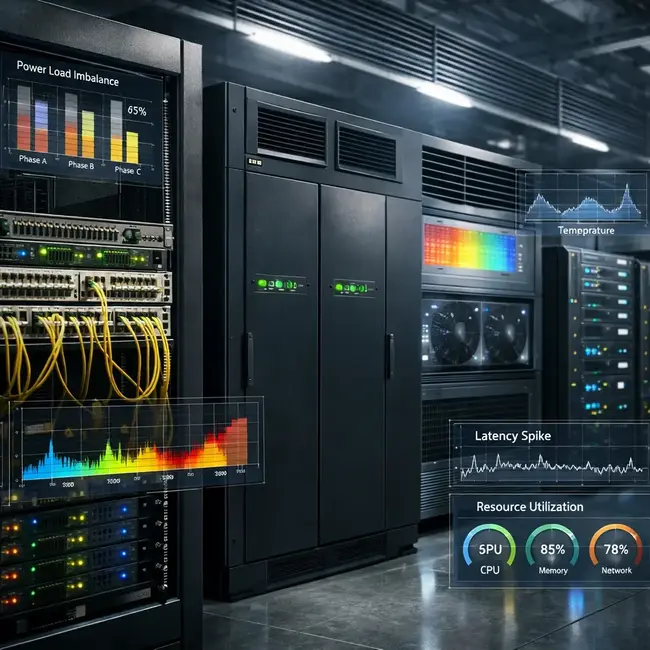
Not all assets carry equal operational weight. Core switches, UPS systems, cooling units and storage platforms typically represent higher risk than auxiliary components. Identifying these assets allows monitoring efforts to focus where failure would have the greatest impact.
Performance indicators should be selected based on failure patterns and operational history. In advanced data center monitoring, metrics such as power load imbalances, temperature gradients, latency spikes and resource saturation provide actionable insights when analyzed alongside historical trends and performance patterns. This targeted approach avoids metric overload while preserving analytical depth.
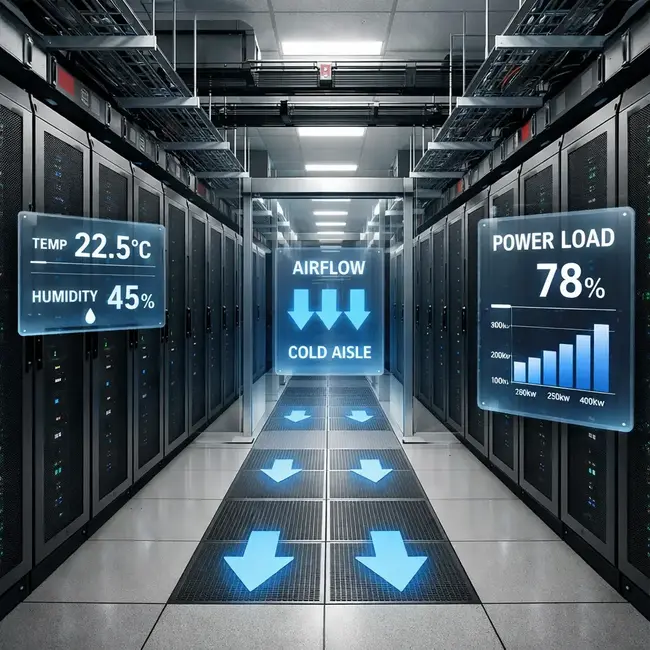
Power, cooling and environmental monitoring provide direct insight into the physical conditions that determine data center stability and hardware lifespan. Continuous monitoring of power quality, load distribution and redundancy status helps identify imbalances or undervalued capacity before they lead to shutdowns or equipment stress. Cooling and environmental data, including temperature gradients, airflow efficiency and humidity levels, reveal inefficiencies that are not visible through IT metrics alone. When analyzed within a unified framework, data center infrastructure monitoring enables precise resource control, reduces thermal risks and supports energy-efficient, reliable operations.
Network and IT equipment performance monitoring focuses on maintaining consistent service levels by tracking how critical hardware and connectivity components behave under real workloads. Metrics such as latency, packet loss, interface errors, CPU load and memory utilization provide early indicators of congestion, misconfiguration, or hardware degradation. By correlating these signals with application performance and physical infrastructure data, operators can distinguish between transient spikes and structural issues. This level of analysis allows data center infrastructure monitoring to support faster fault isolation, reduce mean time to resolution and prevent minor performance deviations from escalating into service-impacting incidents.
Virtual environments introduce additional complexity due to shared resources and dynamic workloads. Monitoring must track host utilization, virtual machine behavior and application dependencies. Advanced data center monitoring integrates these layers to maintain transparency across physical and virtual boundaries.
Effective capacity and resource utilization monitoring provides clear visibility into how power, space, cooling and compute resources are consumed across the data center. By tracking utilization trends and available headroom, organizations can identify underused capacity, prevent resource saturation and plan infrastructure expansion proactively. This approach supports informed capacity planning, reduces unnecessary capital expenditure and ensures that growth is aligned with actual demand rather than reactive estimates.
Modern data center services rely on complex dependencies across physical infrastructure, virtual environments and application layers. Dependency and service mapping make these relationships visible by linking applications to the underlying servers, storage, network and power components they depend on. This visibility enables accurate impact analysis, accelerates root cause identification and helps teams assess the operational risk of changes before they affect critical services.
Isolated metrics provide limited value without context. Data integration and cross-domain correlation combine information from physical infrastructure, IT systems, virtual environments and security controls into a unified analytical view. By correlating events and performance indicators across domains, monitoring platforms can distinguish symptoms from root causes, reduce false alerts and deliver actionable insights that improve operational decision-making and overall data center resilience.

Monitoring physical and digital security controls ensures that both the facility and its information assets are protected against unauthorized access and operational risks. Physical monitoring covers access points, surveillance systems and environmental alarms to confirm that only approved personnel can reach critical infrastructure. Digital security monitoring focuses on authentication events, configuration changes and anomalous behavior within network and system layers. When these controls are monitored together, data center infrastructure monitoring provides unified visibility into security posture, enabling rapid detection of threats, enforcing compliance requirements and reducing exposure to both physical breaches and cyber incidents.
Many industries require documented control over infrastructure conditions. Monitoring data supports audits by providing verifiable records of operational stability and incident handling.
Protecting monitoring data and access rights ensures integrity and confidentiality. Role-based access and secure data handling prevent monitoring systems from becoming attack vectors.
Centralized platforms simplify management and analytics by aggregating all operational data into a unified control plane, enabling greater visibility and streamlined decision‑making. In contrast, distributed data center infrastructure monitoring models enhance resilience and scalability, making them better suited for large‑scale or geographically dispersed data centers. The choice depends on operational scale, latency requirements and fault tolerance goals.
Scalability and flexibility in monitoring design ensure that monitoring systems can evolve in parallel with the data center itself. As infrastructure expands, monitoring architectures must accommodate increased data volumes, new device types and changing performance baselines without requiring disruptive redesigns. A flexible approach allows organizations to integrate additional monitoring tools, cloud resources and virtualized environments while maintaining consistent visibility and control. Flexible, modular monitoring architectures adapt across growth phases, ensuring operational continuity and supporting informed, future‑ready infrastructure decisions.
Implementation begins with validating physical access, network segmentation and compatibility with existing systems. This step avoids deployment delays and reduces integration risks.
Sensors, agents and collectors are deployed as part of a structured data center infrastructure monitoring design, following predefined implementation plans to ensure accurate data collection and system reliability. Placement accuracy and calibration are critical to ensure reliable data streams.
Integration connects monitoring outputs with operational workflows. Tickets, alerts and reports flow into existing management systems, enabling coordinated response and accountability.
Thresholds and escalation policies define how the system reacts to anomalies. Well-defined thresholds reflect operational tolerances rather than default vendor values.
Centralized dashboards provide a unified operational view, allowing teams to assess system health at a glance.
Combined with precise incident detection and root cause identification, real-time monitoring reduces response time and supports informed decision-making during critical events.
Automation reduces manual intervention during routine incidents. Automated workflows can isolate affected components or trigger corrective actions based on predefined rules.
In advanced data center monitoring, predictive analysis leverages historical performance trends to anticipate capacity limitations and detect early signs of component degradation before failures occur.
By leveraging advanced analytics and machine learning, data center infrastructure monitoring evolves from reactive oversight into a forward-looking operational discipline.
Proactive infrastructure management reduces emergency repairs and unplanned outages, translating into measurable cost efficiency. Investments in monitoring pay off through extended equipment lifespan and optimized resource usage.
Reliable infrastructure underpins consistent service delivery. Advanced data center monitoring rapidly identifies performance deviations, enabling timely responses that preserve availability and stability under peak workloads.
As organizations scale, monitoring provides the clarity needed to expand with confidence. Informed infrastructure decisions support long-term growth while maintaining resilience and continuity.
OPM Group designs monitoring frameworks that reflect the actual structure of each data center rather than applying generic templates. Mixed environments with legacy hardware, virtual platforms and hybrid workloads require adaptive monitoring models.
By aligning tools, sensors and analytics with infrastructure realities, OPM Group ensures that data center infrastructure monitoring delivers relevant and reliable insights across all operational layers.
End-to-end planning, deployment and support services focus on creating a monitoring environment that works reliably throughout its entire lifecycle, not just at the point of installation. This process begins with detailed technical planning based on real infrastructure constraints, including power topology, network segmentation, security policies and operational workflows. Deployment is executed in a controlled manner to avoid service disruption, with validation at each stage to ensure accuracy of collected data and correct alert behavior. After implementation, continuous support covers system tuning, threshold adjustments, performance optimization and integration updates as the infrastructure evolves. This approach at OPM ensures that data center infrastructure monitoring remains aligned with operational needs over time.
For more information about our services, please contact our experts via email at:
[email protected] (Germany)
[email protected] (Canada)
A long-term monitoring strategy and infrastructure advisory service is designed to keep monitoring practices aligned with how the data center actually evolves over time. As workloads grow, technologies change, or new compliance requirements emerge, monitoring models, thresholds and data sources must be revisited and refined. This advisory approach leverages advanced data center monitoring through periodic analysis of performance trends, incident patterns and capacity utilization to uncover structural weaknesses and identify opportunities for continuous improvement. By translating monitoring data into practical recommendations for infrastructure upgrades, capacity planning and risk reduction, long-term advisory services ensure that data center infrastructure monitoring continues to support operational stability and informed decision-making rather than remaining a static technical tool.
At OPM Group, we deliver comprehensive PMC tailored to ensure the successful execution of complex industrial and infrastructure projects.Our expertise spans from the bidding stage through to project completion, providing robust support at every phase.
Stay updated with the latest security trends offers by subscribing to our newsletter.
Copyright © 2025 All Rights Reserved.