
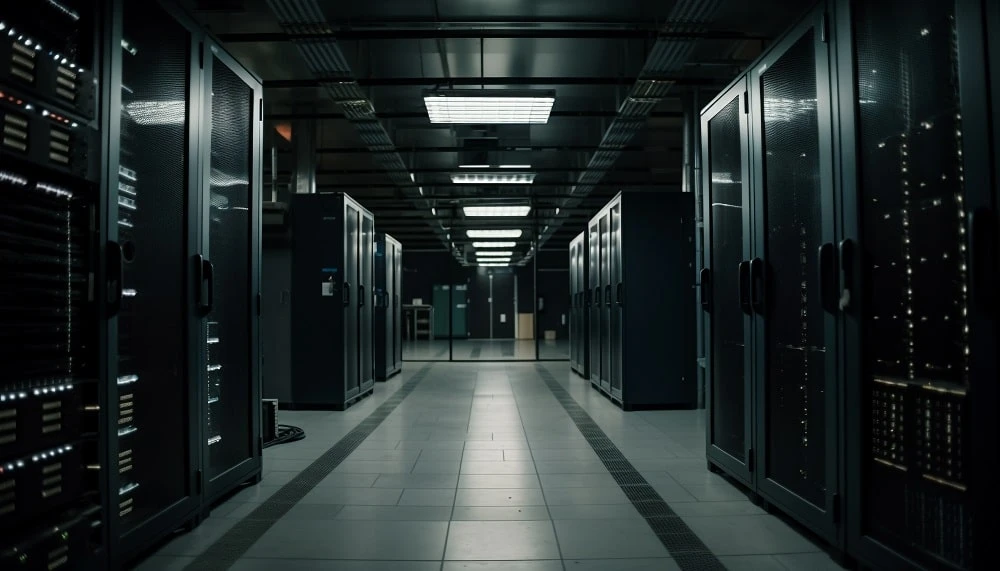
The digital economy is expanding at an unprecedented pace. With the rapid rise of AI applications, cloud computing, IoT devices and data-driven decision-making, the amount of data generated globally is exploding. This surge is creating a pressing demand for high-capacity, highly reliable facilities — data centers — in every major market.
From hyperscale operators to corporate enterprises, businesses cannot afford downtime. Every second of disrupted service can result in lost revenue, damaged reputation and regulatory consequences. Against this backdrop, project management in data centers has become a mission-critical discipline.
OPM Group, with its proven record in large-scale industrial facilities, positions itself as a trusted partner for delivering complex and mission-critical data center projects across Europe, North America and Middle East.
When building a data center, the stakes are high, the budgets are significant and the timelines are tight. Effective and professional project management ensures:
Whether a greenfield project or a brownfield upgrade, OPM Group ensures that every moving part is coordinated — from engineering and procurement to construction management in data centers, commissioning and handover.
Dedicated facilities owned and operated by companies to host their own IT operations.
Facilities leased to multiple clients, with shared infrastructure but isolated environments.
Large-scale sites leased to a single tenant, offering economies of scale.
Compact, modular units deployed close to end-users for low-latency applications.
Regardless of the type, all data centers share critical objectives:
As a specialist in EPC Project Management in Data Centers, OPM Group delivers end-to-end Project Management Consultancy (PMC) services while also providing qualified technical personnel to support both clients and contractors.
Our expertise extends across industrial facilities whose operational demands align closely with those of modern data centers:
These facilities require the same precision in design, redundancy in systems and rigor in construction management in data centers to deliver operational excellence.
Our services span every aspect of EPC delivery:
This stage forms the physical backbone of the data center, directly affecting performance, reliability and scalability. Architectural design and 3D modelling ensures optimal layouts, airflow and separation of IT halls, power rooms and support spaces. Civil works cover site preparation, drainage and precision foundations to prevent stress or vibration on sensitive equipment. Structural engineering delivers frames meeting seismic, wind and snow load codes, with high‑load floors for dense racks and M&E systems. Pre‑engineered cable pathways, corridors and penetrations avoid installation conflicts. Durable, fire‑resistant and climate‑controlled materials maintain stability. Future expansion provisions minimize major alterations. All disciplines—architectural, civil, structural, electrical, mechanical and security—coordinate closely during EPC execution, forming the base for effective project management in data centers.

In data centers, HVAC and precision cooling systems are mission‑critical for maintaining thermal stability and preventing downtime. These systems keep IT halls within ±1 °C and ±5% RH, protecting servers, storage and network gear. Design considers rack densities, hot/cold aisle containment and local climate. Configurations include CRAC/CRAH units, chilled water loops, in‑row and liquid cooling for high‑density racks. Redundancy models (N+1, 2N) ensure continuity during maintenance or failures. Mechanical areas are planned for access, efficient ducting, and unobstructed airflow. Integration with BMS provides real‑time monitoring, fault alerts and predictive maintenance. Energy efficiency strategies—free cooling, economizers, variable‑speed fans—cut costs and support sustainability. Close coordination with electrical and structural design secures adequate space, service paths and installation sequencing, making HVAC a core part of effective project management in data centers.
In mission‑critical data centers, fire safety systems are designed for rapid detection and reliable suppression. Very Early Smoke Detection Apparatus (VESDA) continuously samples air, identifying smoke at the incipient stage. Layered sensors—photoelectric, ionization, heat and flame—enhance coverage in high‑risk zones. While sprinklers meet code, clean agents like FM‑200, Novec 1230, or inert gases (IG‑55, IG‑541) are preferred in IT rooms, suppressing fire without residue or equipment damage. Suppression zones match IT, power and support spaces for targeted protection. All systems integrate with BMS and FACP for centralized monitoring, logging, and alarm escalation. Coordination with architectural and mechanical teams preserves detection sensitivity and agent distribution. Redundant power and controls ensure availability, meeting local codes and global standards. These measures form a vital layer of comprehensive project management in data centers.
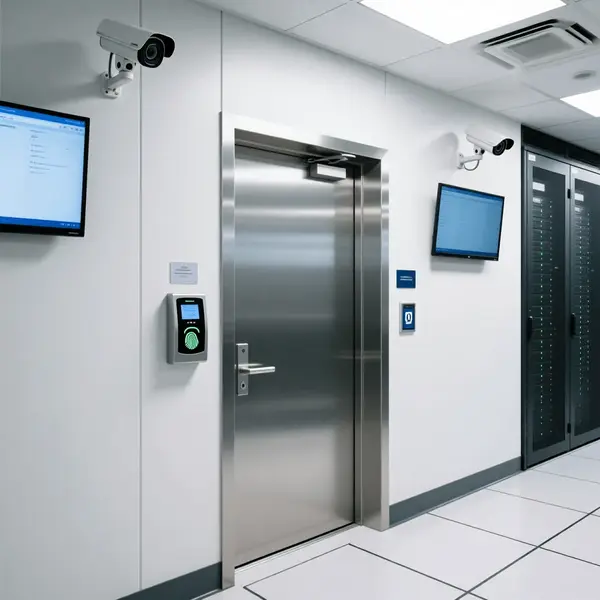
Data center security uses a multi‑layered strategy to protect infrastructure and sensitive data. Perimeter defenses—barriers, bollards, and controlled gates—restrict access, while 24/7 surveillance with high‑resolution, low‑light, and infrared cameras plus video analytics detects intrusions. Within effective project management in data centers, access control uses badges, biometrics, and dual‑factor authentication. Mantraps prevent tailgating into sensitive zones. All entries are logged in a Security Management System (SMS) for audits. Critical areas like server halls, power rooms, and NOCs have tiered authorization. BMS and FACP integration enables automatic door release during fire events or lockdown in breaches. Security, IT, and facility teams align with ISO 27001 and PCI‑DSS standards. Redundant cabling, readers, and control panels ensure operation during outages, giving OPM Group clients in Europe and North America strong defense against physical threats.
Electrical infrastructure powers mission-critical data center systems with clean, continuous energy. Design starts with load analysis for rack density, mechanical systems, and growth. Dual substation high voltage feeds supply step-down transformers, feeding UPS systems that protect against sags, surges, and harmonics. Within effective project management and construction management in data centers, UPS—centralized or distributed—uses VRLA, Li-ion, or flywheel storage for seamless backup. Power then passes through transfer switches and redundant PDUs, with dual A/B feeds per rack. Redundancy topologies (N+1, 2N, 2[N+1]) meet Tier III/IV targets. Generators with rapid start ATS and scalable design sustain operations during outages. Grounding, bonding, and surge protection safeguard equipment and staff. BMS and EPMS monitor loads, optimize energy, and detect faults in real time. Coordination with other disciplines ensures safe, accessible installations. For OPM Group clients in Europe and North America, this framework delivers a robust, scalable electrical backbone.
Instrumentation and control systems are the digital nervous system of data centers, enabling precise monitoring and automation of critical infrastructure. Sensors track temperature, humidity, pressure, flow, and power quality across electrical, mechanical, HVAC, and security subsystems. In advanced project management in data centers, this data feeds into the Building Management System (BMS) and often a Data Center Infrastructure Management (DCIM) platform, allowing real‑time visualization, automated responses, and fault handling. Examples include fan speed modulation, load shedding, and UPS path switchover. Predictive analytics and trend logging help optimize energy, schedule maintenance, and extend equipment life. Systems are built with network and power redundancy, ensuring operation under all conditions. Coordination between engineering, instrumentation, and IT security teams safeguards data integrity, meeting ISO 27001 and Uptime Institute standards. For OPM Group clients in Europe and North America, this ensures compliant, efficient, and resilient data center performance.

Telecommunications and fiber connectivity are the backbone of data centers, delivering high‑capacity, low‑latency links within and beyond the facility. In modern project management in data centers, pathways are designed with diverse PoPs and independent conduits to avoid single points of failure. Structured cabling uses single‑mode fiber for long‑haul carrier links and OM4+ multi‑mode for high‑speed local connections, all to TIA/EIA‑942 and ISO/IEC 11801 standards. Cable trays, raceways, and distribution systems preserve bend radius, reduce attenuation, and separate fiber from copper. Fiber distribution frames and patch panels allow clear labeling, easy access, and scalability, with redundant routes and network failover. OPM Group facilities in Europe and North America connect to multiple Tier‑1 ISPs and cloud on‑ramps (AWS, Azure, Google Cloud), offering carrier‑neutral, resilient connectivity. The NOC monitors latency, packet loss, and optical performance in real time, ensuring reliable, high‑availability network operations.
OPM Group often serves as the client’s representative, managing execution teams to achieve:
With offices in Germany and Canada, OPM Group combines deep technical knowledge with local regulatory expertise.

Define capacity, tier level, budget, and schedule. Conduct location evaluation, power supply studies, and risk analysis.
Align engineering teams with operational needs, ensuring redundancy, thermal management, and energy efficiency.
Source certified equipment and prioritize long-lead items to avoid schedule delays.
Ensure safety, compliance, and quality during all works. In this stage, effective construction management in data centers guarantees that complex building and MEP systems are delivered to specification.
Confirm performance through integrated systems testing, simulations, and load trials.
Deliver documentation, staff training, and optional post-handover facility management.
If you’re considering building or upgrading a data center in Europe, North America, or the Middle East, OPM Group is your trusted partner. With extensive experience in data center project and construction management, we ensure your facility is completed on schedule, within budget, and primed for peak performance.
Reach out to OPM Group today and take the first step toward a successful project.
| Challenge | Solution |
|---|---|
| Tight schedules with no room for error | Phased parallel execution, early stage procurement, and around-the-clock work shifts where needed. |
| Navigating multi-regional compliance | Dedicated compliance teams versed in both European and North American codes. |
| Securing specialized expertise | Access to OPM Group’s pre-approved network of certified professionals. |
If you are planning a new data center construction or upgrade in Europe, North America or Middle East partner with OPM Group. Our proven expertise in project management in data centers ensures your facility is delivered on time, within budget, and ready for operational excellence.
📧 Contact OPM Group today to start your project journey.
It’s applying project management principles to design, build, and commission data centers efficiently, safely, and within budget.
It integrates engineering, procurement, and construction to ensure consistent quality and timely delivery.
Yes — construction management focuses solely on the building, construction, erection and Instalation phase, while project management covers everything from feasibility studies to commissioning.
It varies depending on complexity of the project. It can be from 6 months for micro facilities to 24 months for large-scale enterprise projects.
Because we combine local regulatory expertise, hands-on experience, and rapid team deployment capabilities in both markets.
Submit a Request For This Service
At OPM Group, we deliver comprehensive PMC tailored to ensure the successful execution of complex industrial and infrastructure projects.Our expertise spans from the bidding stage through to project completion, providing robust support at every phase.
Stay updated with the latest security trends offers by subscribing to our newsletter.
Copyright © 2025 All Rights Reserved.