
Complex construction projects rarely fail because of a single technical mistake. Most delays, claims and rework originate at the boundaries between systems, contracts, or teams. Interface management in construction focuses precisely on these boundaries. It provides a structured way to define who is responsible for what, when information must be exchanged and how dependencies are resolved before they turn into disputes.
In modern projects, design is fragmented across multiple disciplines, procurement is distributed among global suppliers and construction activities are executed in parallel. Without construction interface management, assumptions replace coordination. One contractor completes work based on outdated drawings, while another waits for inputs that were never formally assigned. Interface management converts these informal assumptions into documented obligations, reducing ambiguity across the project lifecycle.
At a strategic level, managing interface in construction projects allows project teams to align technical solutions with contractual responsibilities.
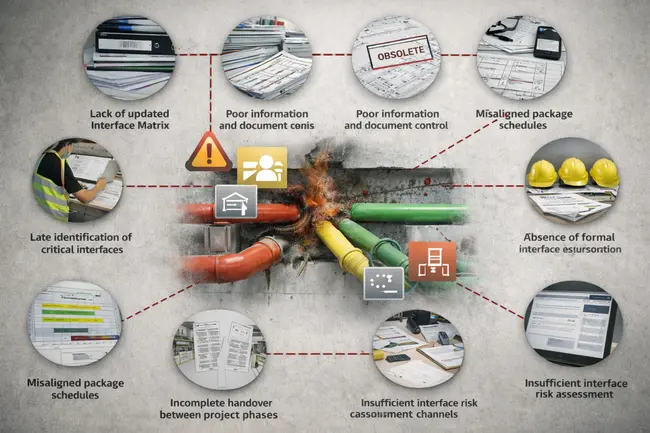
Interface failures often stem from unclear scope boundaries between packages. When design packages are split without a clear definition of shared responsibilities, critical gaps emerge. For example, responsibility for penetrations, tolerances, or temporary works may fall between contractors, leading to late-stage conflicts on site.
Another frequent cause is unmanaged change. Design revisions, value engineering, or supplier substitutions alter interface conditions. If these changes are not assessed from an interface perspective, downstream impacts remain hidden until construction or commissioning. This is where interface management in construction provides measurable value by tracking how changes affect connected systems.
Organizational fragmentation also plays a role. Separate reporting lines, incompatible schedules and isolated decision-making prevent timely resolution of interface issues. In complex developments, the absence of a formal interface process means problems surface only when physical work collides, at which point cost and time impacts are unavoidable.
Lack of updated Interface Matrix
Poor information and document control
Misaligned package schedules
Late identification of critical interfaces
Absence of formal interface issue resolution process
Incomplete handover between project phases
No clearly assigned Interface Owner
Insufficient interface risk assessment
Overreliance on informal communication channels
Lack of integrated digital coordination tools (e.g., BIM-based interface tracking)
Project management acts as the integrator of all interfaces. While designers, contractors and suppliers manage their own scopes, it is the project management function that ensures alignment across boundaries. Effective interface integration requires governance, escalation paths and continuous monitoring rather than ad-hoc coordination meetings.
From a management perspective, interface control is not limited to technical coordination. It also includes aligning schedules, managing information flow and ensuring contractual responsibilities reflect real execution conditions. When interface management is embedded into project controls, it becomes possible to predict interface-related risks rather than react to them.

OPM Group treats interface management as a core project control discipline rather than a supporting function. Interfaces are identified early, classified by risk and complexity and assigned to accountable owners. This ensures that each interface has a single point of responsibility, even when multiple parties are involved.
The methodology focuses on practical execution. Interface registers are linked to schedules, design deliverables and procurement milestones. This allows interface risks to be reviewed alongside progress data, rather than in isolation. By integrating construction interface management into routine project reporting, OPM Group enables timely decisions before issues escalate.
Effective oversight depends on clear governance. Interface review forums, escalation thresholds and approval authorities must be defined from the outset. These structures ensure that unresolved interfaces are visible at the appropriate management level and addressed within agreed timeframes.
Control structures also include performance indicators tied to interface resolution, such as response times and closure rates. This transforms interface management from a reactive coordination task into a measurable management process.
Interfaces evolve as the project progresses. Early-stage interfaces are conceptual and focus on system boundaries. During execution, they become physical and contractual. Recognizing this evolution is essential for managing interface in construction projects effectively.
Technical interfaces define how systems connect and operate together. Examples include load transfer points, power and control connections and spatial coordination. Poorly defined technical interfaces often lead to redesign, site modifications and testing failures.
In interface management in construction, organizational interfaces govern decision‑making authority, communication pathways, and reporting responsibilities; misalignment at this level delays approvals and undermines accountability even when technical solutions are sound.
Contractual interfaces determine risk allocation and scope boundaries. Inconsistent or overlapping contract clauses are a major source of claims. Construction interface management ensures that contractual definitions align with technical and execution realities.
Early planning defines the foundation for all subsequent interface control. During concept and feasibility stages, interfaces should be identified alongside system definitions. Stakeholders and interface owners must be assigned before design packages are finalized.
Clear interface responsibility matrices prevent later disputes by documenting ownership, deliverables and acceptance criteria. This proactive approach reduces the cost of coordination during construction and commissioning.
Design development introduces the highest volume of interface changes. Coordinating architectural, structural and MEP interfaces requires continuous alignment of assumptions, tolerances and sequencing. Interface documentation ensures that design changes are assessed for their cross-disciplinary impact.
Controlling design interfaces also supports constructability by identifying conflicts before drawings reach the site. This reduces rework and improves schedule reliability.
In interface management in construction, procurement decisions reshape project interfaces by introducing suppliers with proprietary systems and operational constraints. Aligning scope definitions across contractors and vendors is essential to avoid mismatched deliverables.
Interface clauses in contracts formalize coordination obligations, while supplier interface management ensures compatibility between equipment, installation methods and commissioning requirements.
During construction, interfaces become physical and time-sensitive. On-site coordination between trades must be supported by accurate interface data and realistic sequencing. Temporary interfaces, such as access, temporary utilities and supports, require the same level of control as permanent works.
Active interface management during construction reduces work stoppages, safety risks and last-minute design clarifications.
Interface registers form the operational backbone of effective interface coordination. Each register records the interface description, involved parties, technical references, required deliverables, dependencies and closure criteria. More importantly, it assigns a clear owner to every interface, eliminating ambiguity about accountability. When linked to the project schedule and design milestones, interface registers allow teams to identify interfaces that are at risk of delaying downstream activities. Regular updates transform the register from a static list into a live management tool, highlighting overdue actions, unresolved inputs and emerging conflicts. This structured tracking enables project managers to prioritize critical interfaces, escalate issues in a timely manner and prevent coordination gaps from reaching the construction or commissioning stage.
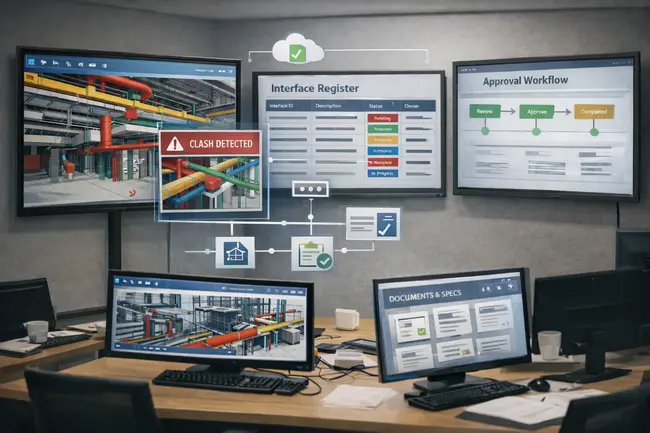
BIM provides a shared visual environment where interfaces between disciplines, systems and packages can be identified and reviewed before physical work begins. Clash detection helps reveal spatial and functional conflicts that traditional drawings often fail to capture. Beyond modeling, digital platforms strengthen construction interface management by connecting BIM models with drawings, specifications, interface registers and approval workflows. This integration ensures that interface decisions are based on current information and that changes are communicated consistently across all parties. Digital traceability also supports auditability, allowing teams to understand why interface decisions were made and how they impact execution and handover.
Clear communication and decision-making workflows are essential for managing interface in construction projects where multiple parties share responsibilities. Structured workflows define how interface issues are identified, who reviews them and which authority approves resolutions. This prevents delays caused by unclear escalation paths or parallel decision-making. Documented workflows also establish response times and information requirements, ensuring that interface questions are addressed with the necessary technical and contractual context. By formalizing communication, project teams reduce reliance on informal discussions and personal follow-ups. The result is consistent decision-making, improved transparency and a reliable record of how interface challenges were resolved throughout the project.

Testing and commissioning represent the point at which interface issues can no longer remain theoretical. Systems must operate together under real conditions and any unresolved interface quickly becomes a functional failure. Effective interface management in construction at this stage starts with clearly defined responsibilities for test preparation, execution and issue resolution. Each system interface must have agreed data exchange requirements, testing sequences and acceptance criteria to avoid delays caused by incomplete readiness.
Handover interfaces between construction and operations are equally critical. Incomplete documentation, unclear asset boundaries, or missing performance data can disrupt operational readiness and increase early-life operational risk. Closing open interfaces before project completion requires formal verification, documented acceptance and alignment with contractual closeout conditions. This disciplined approach ensures that performance targets are met and that the transition from construction to operation is controlled and predictable.
Documenting interface challenges and solutions provides practical insights for future projects. These lessons contribute to the continuous improvement of interface management practices across complex projects.
At a program level, standardized interface processes enable consistency across multiple projects. This approach strengthens organizational capability in managing interface in construction projects at scale.
At OPM Group, we deliver comprehensive PMC tailored to ensure the successful execution of complex industrial and infrastructure projects.Our expertise spans from the bidding stage through to project completion, providing robust support at every phase.
Stay updated with the latest security trends offers by subscribing to our newsletter.
Copyright © 2025 All Rights Reserved.