
Complex construction and infrastructure projects involve many interlinked activities, contracts, and financial commitments. Project Delay Analysis plays a critical role when delays occur, as their impact rarely stays limited to the schedule. A postponed activity can affect procurement, workforce allocation, equipment planning, and key contractual milestones.
It helps project teams understand when a delay occurred, how it influenced the critical path, and whether it changed the overall project completion date. It also supports the fair allocation of responsibility when multiple delay events overlap and the situation becomes more complex.
Using structured analytical techniques, specialists examine schedules, progress reports, and project records to reconstruct the timeline of events. OPM Group applies internationally recognized methodologies and industry expertise to deliver clear, defensible delay analyses for projects across Europe, Canada, and the United States.
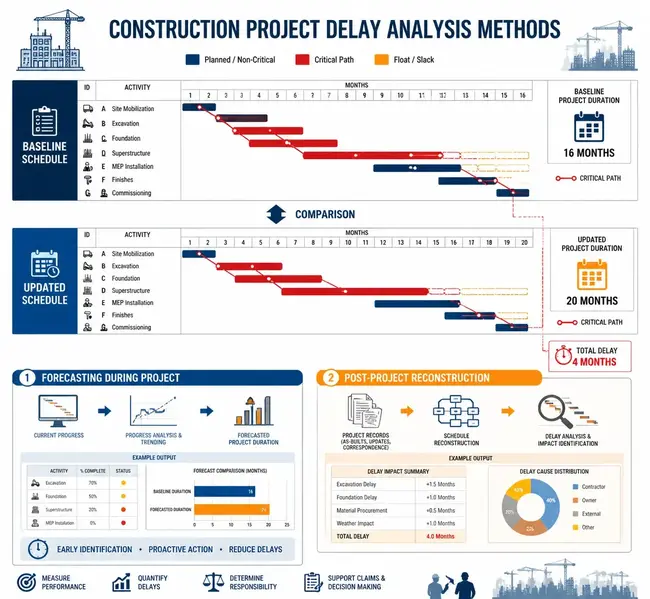
Different projects require tailored analytical approaches for examining delays. Choosing the right delay analysis method depends on the quality of available schedule records, when the analysis is done, and the overall purpose. Some techniques are used while the project is ongoing and focus on forecasting impacts, while others reconstruct what happened after the project is finished.
Most common methods rely on comparing baseline and updated schedules to identify the critical path and measure how delays affected project milestones. Analysts use these tools to simulate the effects of delay events or to analyze what actually occurred over time. Each method has specific assumptions, data needs, and complexity.
By understanding the differences between these approaches, project teams can select the most suitable method for their project’s circumstances and the required level of accuracy. This helps ensure effective resolution of delay claims and supports fair project management decisions.
Project Delay Analysis often uses the As‑Planned vs As‑Built method as a straightforward way to compare the original project schedule with the sequence of activities that actually occurred during construction. Analysts review the baseline schedule and map the real progress of work to identify differences between planned and actual timelines.
This approach provides a broad overview of how the project developed over time. By comparing the two schedules, analysts can identify major deviations, inactive periods, or activities that took longer than expected. Because of its simple structure, the method is often used for preliminary assessments or when detailed schedule updates are limited.
However, this method may not fully capture the dynamic nature of schedule changes during the project. When multiple delay events occur at the same time or when schedules are frequently revised, the comparison can oversimplify how different delays interacted.
Time Impact Analysis (TIA) evaluates delays by inserting individual delay events into the project schedule to measure their impact on the critical path. The analysis is typically performed using the schedule update that existed at the time the delay occurred.
This technique is frequently used for prospective assessments during project execution. When a delay event arises—such as design changes or unforeseen site conditions—the analyst introduces a modeled activity representing the delay into the schedule. The resulting change in project completion time shows how the event affects the overall timeline.
Because TIA analyzes delays in the context of the schedule status at the time they occurred, it often provides a more realistic representation of project conditions. However, it requires detailed and reliable schedule updates to produce accurate results.
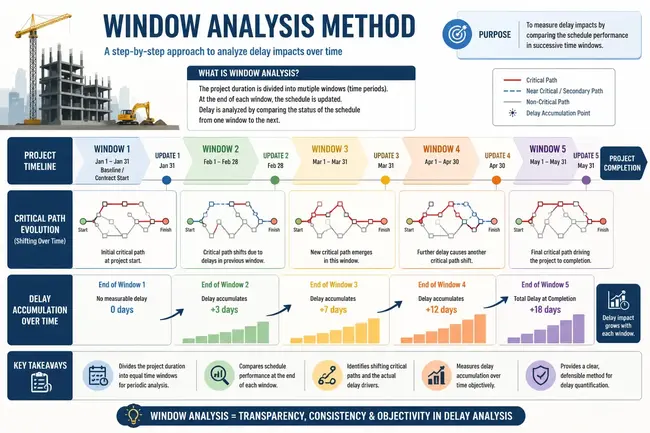
The Window Analysis method is a structured technique used in Project Delay Analysis to understand how delays evolve over time. It divides the project timeline into several periods or “windows,” typically aligned with schedule updates. Analysts review each window to see how the critical path shifted and which delay events influenced the schedule during that phase.
This segmented approach helps show how delays accumulate and interact throughout the project. By analyzing schedule changes step by step, it captures the dynamic nature of progress and clarifies how specific events affected overall performance.
In complex disputes, Window Analysis is widely used because it demonstrates the impact of different delay events at various project stages. However, the method requires consistent schedule updates and detailed project records to accurately reconstruct each analytical window.
The Collapsed As-Built method begins with the actual completed schedule of the project. Analysts then remove specific delay events from the as-built timeline to estimate what the completion date would have been “but for” those delays.
By sequentially removing delay events and recalculating the schedule, analysts can measure how each event contributed to the overall delay. This retrospective approach is often applied in forensic analysis when the project has already been completed.
While the method can provide a detailed reconstruction of delay impacts, it relies heavily on accurate as-built data and assumptions regarding the interaction between removed activities and remaining project work.
Different analytical approaches provide varying levels of precision and reliability. In Project Delay Analysis, the selected method must align with the quality of available schedule data, the timing of the assessment, and the purpose of the evaluation. Some techniques offer a broad overview, while others deliver a detailed, event‑based examination of how delays affected the critical path.
A technical comparison highlights differences in data requirements, analytical complexity, and the strength of conclusions each method can support. Understanding these distinctions helps project teams choose an approach that fits the project’s documentation, dispute context, and required level of accuracy.

Some Delay Analysis Methods require highly detailed scheduling data. Techniques such as Time Impact Analysis and Window Analysis rely on regularly updated schedules that reflect the project’s evolving status. Without these updates, analysts may not be able to reconstruct the schedule logic accurately.
In contrast, simpler methods like As-Planned vs As-Built can be performed with limited data. However, the lack of intermediate schedule updates may reduce the reliability of conclusions, especially in projects with numerous overlapping delays.
The reliability of delay analysis depends largely on how well the method reflects actual project conditions. Methods that incorporate schedule updates—such as TIA and Window Analysis—generally provide more precise results because they evaluate delays within the evolving project context.
Simpler comparisons between planned and completed schedules may overlook changes in the critical path. As a result, they may attribute delays to activities that were not controlling project completion at the time.
Large infrastructure and industrial projects often generate extensive scheduling data and regular progress updates. These projects are well suited for analytical methods that rely on detailed schedule modeling.
Smaller projects may not maintain the same level of schedule documentation. In such cases, analysts may rely on simplified approaches combined with project records, correspondence, and site reports.

Every method used in Project Delay Analysis provides a different balance of clarity, effort, and evidentiary strength. Some approaches offer a fast way to understand how delays influenced the project timeline, making them useful for early assessments or situations with limited documentation. Other methods deliver a more detailed and defensible picture but require stronger schedule data and deeper investigation.
These advantages and limitations do not make any method universally superior; instead, they highlight the importance of matching the technique to the project’s actual conditions. Factors such as the availability of reliable updates, the complexity of the schedule, and the purpose of the analysis all influence which method will produce the most meaningful results. By understanding the strengths and constraints of each approach, teams can apply the selected method more effectively and avoid relying on techniques that the existing data cannot properly support.
Some methods used in Project Delay Analysis are relatively quick to implement and provide an initial overview of delay impacts. Others require extensive schedule reconstruction but produce more detailed results. For example, As‑Planned vs. As‑Built analysis is straightforward and easy to communicate, but it may oversimplify complex delay interactions. Window Analysis offers a clearer picture of how delays evolved over time, although it depends heavily on consistent and reliable schedule updates.
Even well-established Delay Analysis Methods can produce misleading conclusions if the underlying assumptions are not clearly documented. Decisions regarding which activities to include, how to interpret schedule logic, or how to model delay events may introduce subjectivity into the analysis.
Professional delay analysts address this risk by documenting assumptions, validating schedule logic, and cross-checking conclusions with project records. Transparent analytical procedures reduce the likelihood of conflicting interpretations between project stakeholders.
The selection of a delay analysis method should reflect the characteristics of the project and the available documentation.
Projects with extensive documentation, regular schedule updates, and detailed progress tracking provide a stronger foundation for sophisticated analytical methods. Analysts can reconstruct the sequence of events with greater precision and evaluate how the critical path evolved over time.
When documentation is limited, analysts must rely on alternative evidence such as correspondence, site reports, and meeting minutes to reconstruct the project timeline.
Many construction contracts specify procedures for evaluating delays and extensions of time. In dispute situations, tribunals and arbitration panels often expect delay analyses to follow recognized professional standards.
Selecting a method that aligns with accepted industry guidelines increases the credibility of the analysis and facilitates communication between technical experts and legal professionals.

OPM Group provides Project Delay Analysis services as an independent technical advisor to contractors, project owners, and legal teams. The analysis process focuses on objective evaluation of schedule data, project documentation, and delay events.
Rather than applying a predefined template, the analytical approach is adapted to the structure of each project. Analysts review baseline schedules, progress updates, change orders, correspondence, and site reports to reconstruct the timeline of events. Based on this evidence, the most suitable Delay Analysis Methods are selected to evaluate the impact of delays on project completion.
The resulting analysis is structured to present clear reasoning, transparent calculations, and documented assumptions. This structured presentation allows project stakeholders to understand how conclusions were reached and how specific delay events influenced the schedule.
OPM Group supports projects across multiple jurisdictions through its offices in Germany and Canada. From its European office, the company assists projects throughout the EU, while its Canadian office serves clients across Canada and the United States.
This cross-regional presence allows OPM Group to work with clients operating in international construction environments where contract structures, regulatory frameworks, and dispute mechanisms may differ. By combining regional knowledge with established analytical methodologies, OPM Group delivers delay analysis services that reflect both technical rigor and practical project experience.
At OPM Group, we deliver comprehensive PMC tailored to ensure the successful execution of complex industrial and infrastructure projects.Our expertise spans from the bidding stage through to project completion, providing robust support at every phase.
Stay updated with the latest security trends offers by subscribing to our newsletter.
Copyright © 2025 All Rights Reserved.