
A well-prepared Commercial proposal in tender is not just a price sheet. It is the commercial translation of the project scope, technical solution, execution strategy, contractual obligations, risks and market conditions. For complex projects, especially in oil and gas and data center sectors, even small pricing gaps can affect bid competitiveness, profit margins and project delivery performance.
OPM supports companies in preparing accurate, competitive and defensible tender Commercial proposal packages. Our service covers the full process from cost estimation to final bid pricing, with strong attention to technical alignment, contract requirements, regional market conditions, risk exposure and client submission instructions.

A tender price is not only evaluated based on the final number. Clients often review how complete, realistic and commercially controlled the proposal appears. A weak financial structure may lead to clarification issues, negotiation pressure, or execution losses after contract award.
strong Commercial proposal in tender should:
This is why cost estimation alone is not enough. The estimated cost must be reviewed, adjusted, structured and converted into a final bid price that supports both competitiveness and safe project delivery.

International tenders often include strict commercial and contractual requirements. These may involve specific submission formats, pricing schedules, currency rules, tax treatment, insurance levels, performance bonds, liquidated damages, payment terms and clarification procedures.
OPM reviews these requirements before the pricing model is finalized. This helps ensure that the tender Commercial proposal is not only technically accurate but also commercially compliant.
For example, a price may seem competitive at first, but the actual margin can be reduced by:
With experience across Europe, the United States and Canada, OPM helps companies shape pricing structures that reflect the target market and the client’s tender evaluation criteria.
OPM treats cost estimation as the foundation, not the final answer. Estimated costs are reviewed, categorized, adjusted and converted into a bid price that supports both competitiveness and delivery.
The process includes checking direct costs, indirect costs, supplier quotations, labor assumptions, logistics, project duration and risk exposure. After that, margins and contingencies are applied based on the tender strategy.
This approach helps avoid two common problems: submitting a price that is too high to compete, or a price that is too low to deliver safely. A strong commercial proposal in tender should be realistic, traceable and aligned with the scope.
Risk management should start before the final price is submitted. OPM identifies time and cost-related risks that may affect project delivery and commercial performance after contract award.
These risks may include:
Once risks are identified, they can be priced, qualified, clarified, or managed through commercial assumptions. This improves the bidder’s position and reduces the chance of margin erosion during execution.
Bid success is not only about offering the lowest price. Many clients prefer a proposal that appears complete, controlled and reliable. A defendable tender commercial proposal helps build confidence during evaluation and negotiation.
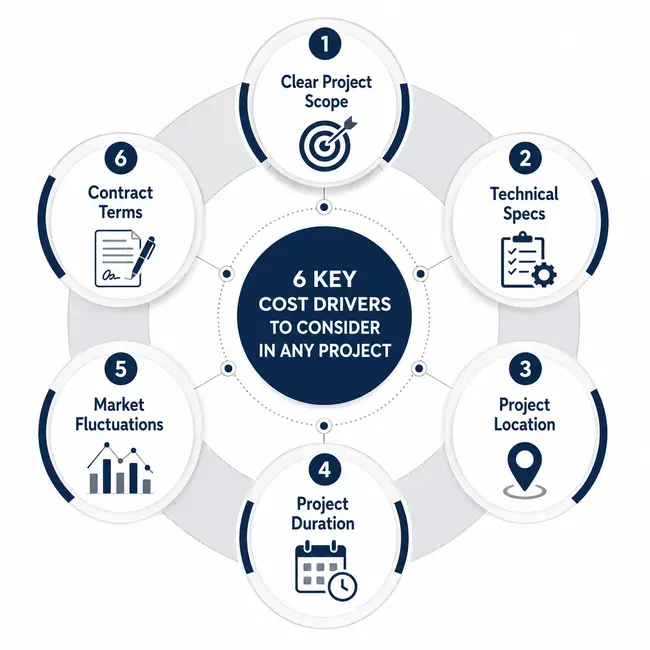
A commercial proposal must accurately reflect the technical solution. If the technical team specifies certain systems, materials, equipment, construction methods, or performance standards, the pricing must include the real cost of those decisions.
OPM helps bridge the gap between technical input and commercial output by reviewing:
Contractual terms are also critical because they can significantly change the project cost profile. Warranty periods, payment milestones, penalties, insurance requirements, bonds and performance guarantees all influence the final price.
By aligning financial, technical, contractual and execution requirements, OPM helps prepare a financial proposal in tender that is complete, consistent and commercially reliable.
For clients, OPM prioritizes transparency, compliance, risk coverage, and price defendability. On the contractor side, our focus shifts to accurate cost estimation, realistic execution assumptions, supplier inputs, contractual exposure, and margin protection. With our management consultancy (MC) expertise, we provide deep insight into how commercial proposals are compared, clarified, and assessed during the tender evaluation process.
Companies can request OPM’s support at different stages of the tender process. Some clients need a complete tender commercial proposal package, while others require cost validation, pricing strategy development, bid review, or final price assessment before submission.
The first step in preparing a commercial proposal in tender is a detailed review of the tender documents. This includes the scope of work, bill of quantities, drawings, specifications, contract conditions, commercial instructions, submission forms and clarification responses.
OPM identifies pricing requirements that may not be obvious at first reading, such as:
This review helps prevent missing items that could become costly after contract award. It also establishes a clear baseline for the tender pricing structure.
Tender pricing cannot be treated as a universal model across all regions. Labor rates, supplier behavior, tax structures, logistics, permitting requirements and contract expectations vary from one market to another.
OPM structures each tender commercial proposal based on the target region and project environment.
In Europe, our Germany office supports market alignment and tender expectations. In the United States and Canada, our Canada office supports regional commercial and pricing conditions.
This local understanding improves the quality of pricing assumptions, especially in specialized sectors such as:
A regionally aligned financial proposal is more realistic, more defendable, and better suited to the client’s evaluation process.
The final bid price must achieve three objectives at the same time:
OPM reviews the cost base, assumptions, exclusions, risk items, margin and commercial conditions before final submission. The goal is to avoid unexplained pricing gaps between the technical and commercial proposal.
A defendable commercial proposal in tender gives the bidder more confidence when responding to client questions. It also helps internal decision-makers understand why the final price is appropriate for the project, the contract and the target market.
Tender documents define what must be priced and how the offer must be submitted. OPM reviews technical specifications, drawings, schedules, commercial terms, contract drafts and submission templates.
Baseline information also includes client requirements, site data, execution conditions, procurement expectations and any clarification responses issued during the tender period.
This step creates the pricing foundation. If the baseline is incomplete, the estimate may miss required items. A strong review helps ensure that the commercial proposal in tender follows the client’s instructions and reflects the actual project requirements.
The scope of work must be clear before pricing starts. OPM breaks the scope into cost-driving elements such as engineering, equipment, materials, construction, installation, testing, commissioning, logistics, project management and site support.
Some items have a stronger impact on the final price than others. In data centers, power and cooling systems may dominate the cost. In oil and gas, specialized equipment, construction conditions and safety requirements can drive pricing.
By identifying these items early, the cost estimation process becomes more accurate and easier to review before submission.
Direct costs are linked to physical delivery. They include equipment, materials, labor, subcontractors, installation, testing and commissioning. These costs are usually easier to trace because they connect directly to the scope.
Indirect costs support the project but may not appear in a single work item. They include management, engineering coordination, site facilities, supervision, quality control, administration and overhead.
Both cost groups must be included in the commercial proposal. Missing indirect costs may make the bid look competitive, but it can damage project margin after award.
Estimated cost is not the same as final bid pricing. After the cost base is prepared, OPM reviews risk exposure, contract conditions, market competition, payment terms and the bidder’s commercial strategy.
Final pricing may include contingency, profit, escalation allowances, tax effects, insurance, bonds, financing costs and currency exposure. Each item should be included with a clear reason.
This step turns project cost estimation into a structured commercial proposal in tender that can be submitted to the client and defended if clarification is requested.
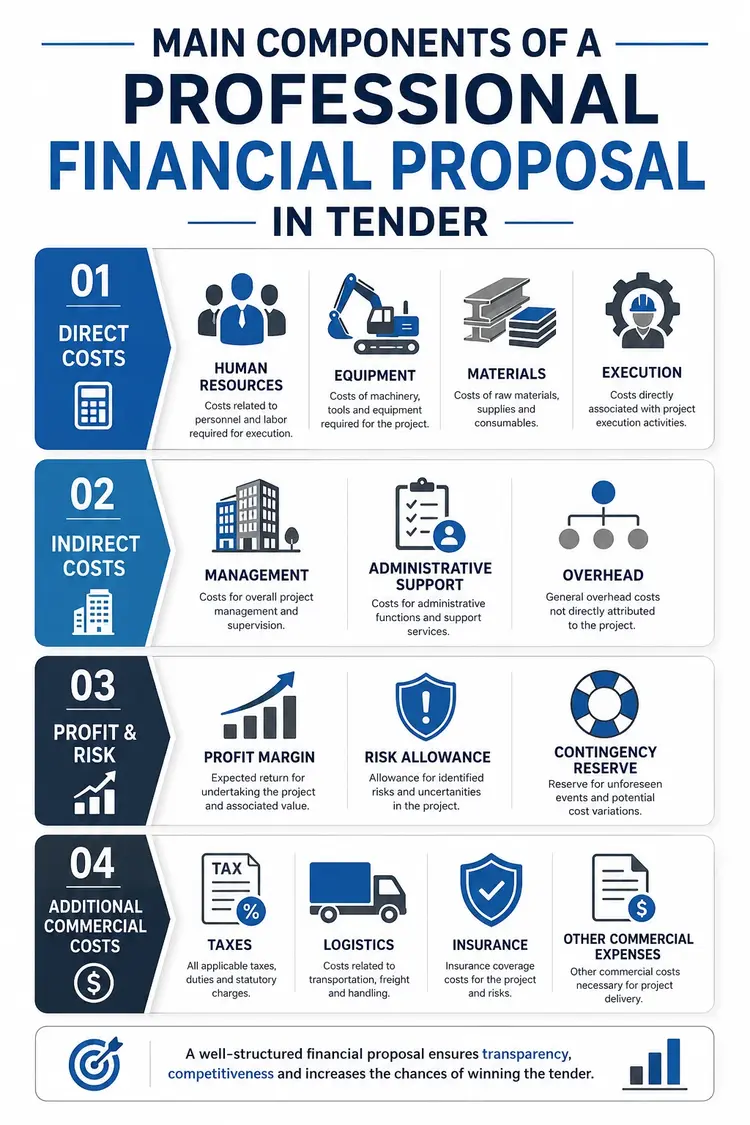
A professional financial proposal should be clear enough for the client to understand and detailed enough for the bidder to manage risk. It should show what is included, how costs are organized and which assumptions support the final price.
Direct costs are the most visible part of the financial proposal. They include equipment, materials, labor, subcontracted works, installation, testing, commissioning and site execution.
For oil and gas projects, direct costs may include process equipment, piping, electrical systems, instrumentation, civil works and safety-related requirements. For data centers, they may include power systems, cooling systems, racks, cabling, fire protection, controls and commissioning.
OPM reviews these items against the technical scope. This helps ensure that the commercial proposal in tender covers what the bidder has promised to deliver.
Indirect costs support delivery but are not always tied to one physical item. They may include project management, engineering support, procurement coordination, document control, quality assurance, HSE management, site administration and company overhead.
These costs are easy to underestimate, especially when the tender deadline is tight. However, they affect real project performance after award.
OPM includes indirect costs in a structured way, so the tender financial proposal reflects the full cost of execution. This prevents the bid from relying only on visible materials and labor while ignoring the support needed to deliver the project.
risk allowance,profit and contingency are not the same. Profit is the commercial return expected from the project. Risk allowance covers known risks that may affect cost. Contingency protects against uncertainty within reasonable limits.
OPM separates these elements when preparing pricing logic. This gives decision-makers a clearer view of how the final number was built.
In a commercial proposal in tender, these items must be balanced carefully. Too much risk allowance can make the bid uncompetitive. Too little can create financial pressure during execution. The right level depends on scope clarity, contract terms, market conditions, and project complexity.
Commercial costs can change the final price significantly. Taxes, duties, freight, customs, insurance, bonds, permits, financing charges and currency conversion should be reviewed before submission.
For international projects, logistics and tax treatment can be especially important. Equipment may cross borders, suppliers may quote in different currencies and delivery conditions may shift cost responsibility between buyer and contractor.
OPM includes these items in the project cost estimation and final pricing review. This helps avoid submitting a price that looks complete but excludes commercial costs that must be paid later.
At OPM Group, we deliver comprehensive PMC tailored to ensure the successful execution of complex industrial and infrastructure projects.Our expertise spans from the bidding stage through to project completion, providing robust support at every phase.
Stay updated with the latest security trends offers by subscribing to our newsletter.
Copyright © 2025 All Rights Reserved.