
In today’s competitive and fast‑shifting economic environment, companies and large‑scale projects must adapt rapidly to remain relevant. Whether the trigger is market pressure, digital disruption, or strategic growth, transformation needs structure. This is where Re Structural Advisory for Organizations plays a crucial role — ensuring change is effective, strategic and sustainable.
At OPM Group, with offices in Germany (covering Europe and the Middle East) and Canada (serving North America), we provide targeted Organizational restructuring and Organization Structural optimization services to align strategy, structure and execution. Our method enables organizations to optimize operations, redesign business models and deliver large‑scale projects with maximum efficiency.
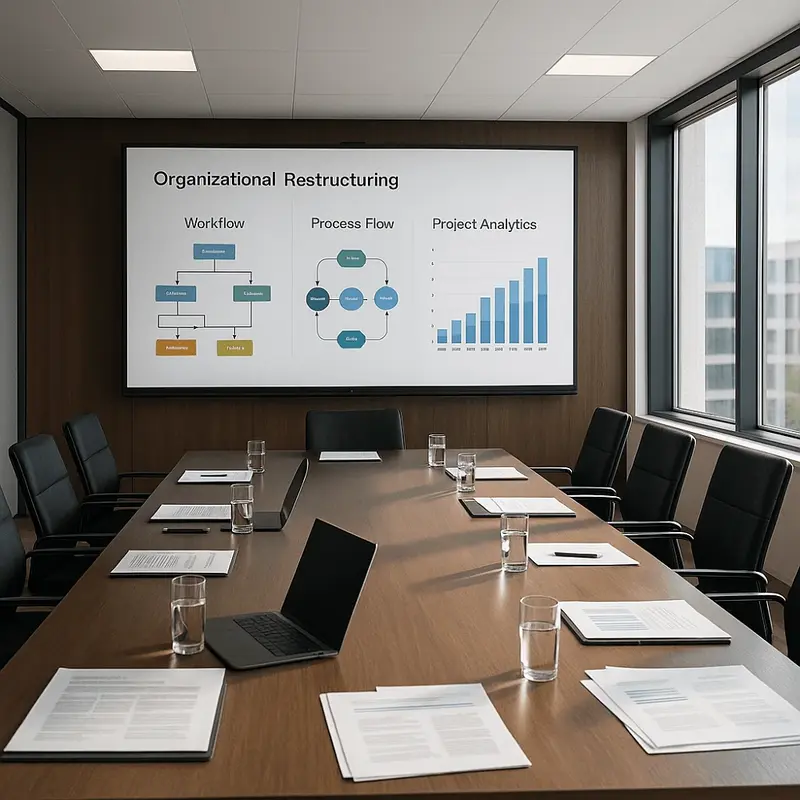
Organizational restructuring is no longer about cost‑cutting alone — it’s a strategic re‑engineering of your organizational DNA to meet current and future challenges.
When done right, it drives:
This means building flexible reporting lines, cross‑functional teams and agile decision‑making processes that can quickly reallocate resources and adapt strategies in response to market volatility, technological advancements or emerging competitive threats.
Establishing standardized operating procedures, unified reporting frameworks, and shared best practices ensures that regardless of geographical location or project specifics, the organization maintains a predictable level of quality and efficiency.
Designing an organizational structure that can accommodate increased volume, new market entries or expanded service offerings without compromising existing operations or introducing significant bottlenecks is a core objective of Re Structural Advisory for Organizations, ensuring the foundation for sustainable expansion.
Building robust contingency plans, diversifying operational capabilities and fostering a culture of continuous improvement enables organizations to withstand and even capitalize on unforeseen challenges or industry‑wide shifts.
Our Re Structural Advisory for Organizations process ensures that stakeholders across leadership, management and project delivery speak the same operational language. This shared understanding reduces ambiguity, improves interdepartmental collaboration and fosters unified commitment to organizational objectives. Modern organizations are complex entities with multi‑layered processes, diverse teams and global interactions. In this environment, even small inefficiencies can create significant operational drag. Through our Re‑Structural Advisory, we systematically analyze workflows, communication channels and decision‑making pathways to identify and eliminate points of friction and waste—helping organizations operate at peak efficiency while remaining adaptable to change.
We re‑align your organizational setup to be truly project‑centric, enabling each project to operate as a high‑performance unit while maintaining strategic cohesion. Through our Re Structural Advisory for Organizations, this transformation becomes especially vital for EPC (Engineering, Procurement and Construction) projects, where cross‑discipline integration directly determines success. By structuring around project needs, we ensure that all necessary functions are readily available and aligned for each specific endeavor, leading to improved resource utilization and faster delivery cycles.
Example: A renewable energy EPC firm in Europe improved delivery speed by 18% after we implemented a hybrid matrix structure dedicated to each project cluster. This structure, guided by our Re‑Structural Advisory approach, allowed project managers to have direct authority over project teams—fostering accountability and quicker decision‑making—while still leveraging functional expertise from specialized departments.
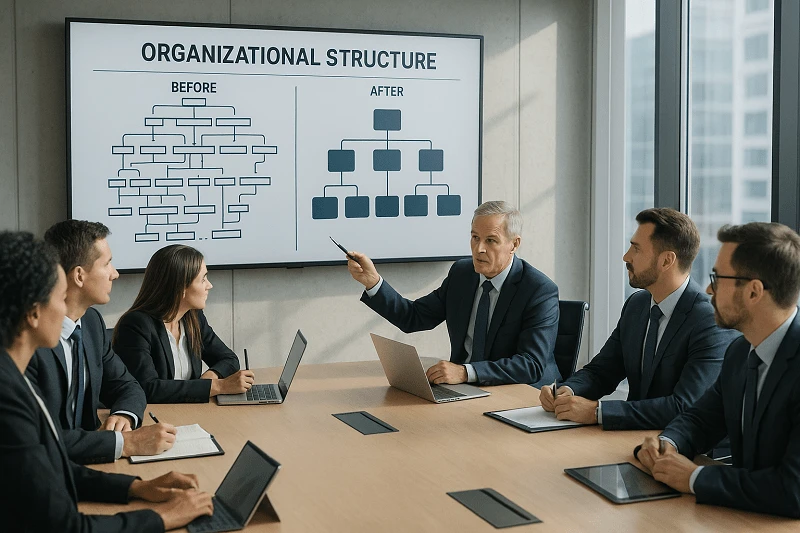
This is the science of ensuring “the right people are in the right places with the right processes.” We analyze reporting lines, decision‑making flows and communication channels to eliminate bottlenecks and duplication. This involves a deep dive into the current organizational chart, identifying reporting hierarchies, span of control, and the formal and informal communication pathways. Our goal is to create a lean, effective structure that empowers individuals and teams.
Benefit: Clients often see a 10–25% efficiency gain in decision turnaround times after optimization. This is achieved by flattening hierarchies where appropriate, delegating authority closer to the point of action and streamlining approval processes.
Markets evolve — your business model should too. We help organizations pivot or expand into new revenue models. From traditional contracting to integrated service packages, we ensure the structure supports the new model without operational friction. This can involve shifting from transactional sales to recurring revenue streams, moving from product-centric to service-centric offerings or developing platform-based business models.
Case Insight: A traditional construction contractor shifted to a full EPC model, supported by our redesign of their management layers, leading to 30% higher bid success rates. This transition required restructuring to integrate design, procurement and construction capabilities under a unified management system, enabling them to offer more comprehensive solutions and better manage project risks.
We prepare your teams, systems, and processes for immediate operational execution. This includes readiness assessments, implementation roadmaps and cross‑departmental alignment. Operational readiness ensures that a newly designed structure or a significant process change is effectively embedded and functions as intended from day one, minimizing the learning curve and potential disruptions.
Standardization is the bedrock of quality. Through Re Structural Advisory for Organizations, we design or refine procedures to meet ISO standards, ensuring compliance and boosting operational credibility in global markets. Adherence to ISO standards, such as ISO 9001 (Quality Management) or ISO 14001 (Environmental Management), demonstrates a commitment to best practices and can open doors to new international partnerships and contracts.
We integrate or upgrade your project management systems to align with best practices like PMBOK, PRINCE2 and agile methodologies — adapted for your industry. This involves selecting, configuring and implementing robust project management software and ensuring that project managers and teams are trained in its effective use. The goal is to provide tools for better planning, execution, monitoring and control of projects.
Tip: ISO‑compliant project systems not only enhance quality assurance but also support international partnership opportunities. By having well-documented, standardized processes that align with internationally recognized standards, organizations can build trust with global partners and clients.
In complex EPC environments, contracts, workflows and teams must synchronize. We align engineering, procurement and construction functions into a seamless delivery pathway. This involves establishing clear interfaces between these core disciplines, defining responsibilities and creating integrated project plans that account for the interdependencies of each phase.
Instead of a rigid hierarchy, this structure brings all project functions (design, procurement, quality control, HSE, commissioning) under a unified control structure specific to the project. This creates dedicated, empowered project teams where all necessary expertise is co-located or closely integrated, fostering collaboration and efficient problem-solving.
We create end‑to‑end workflows for EPC contracts, integrating vendor management, supply chain logistics and field execution to reduce delays and cost overruns. Leveraging Re Structural Advisory for Organizations, we map out the entire lifecycle of an EPC project—from initial tender and contract award through detailed engineering, procurement of materials and equipment, construction and final commissioning and handover. Each step is optimized for efficiency and risk mitigation.
Result: Clients have reported a 12% reduction in critical path delays after implementing our EPC workflows. This improvement is driven by better coordination, proactive risk management and streamlined communication between different project phases and stakeholders.

We help organizations transition between industries — for example, moving from agriculture or pharmaceuticals into the energy sector. This involves structural adaptation, capability upgrades and compliance recalibration. Such transitions require a fundamental understanding of the new industry’s operational requirements, regulatory landscape and competitive dynamics.
We assess existing competencies and strategically reassign or upgrade them to meet new operational goals. This could involve upskilling existing employees, acquiring new talent or divesting non-essential capabilities. The aim is to ensure the organization has the necessary skills and knowledge to succeed in its chosen markets.
Outcome: Better utilization of human capital often leads to increased employee engagement and retention. When employees see opportunities for growth and development and their skills are aligned with the organization’s strategic direction, job satisfaction and loyalty tend to increase.
When moving into a higher‑value segment, we re‑position your organization structurally and strategically to compete effectively from day one. Through our Re Structural Advisory for Organizations, this shift can involve investing in advanced technologies, developing specialized expertise, enhancing brand perception and restructuring sales and marketing functions to target a new customer base.
Example: A mid‑tier manufacturing firm repositioned into high‑tech energy solutions with our advisory support and secured three international contracts in its first year. This achievement was driven by a comprehensive restructuring that included building new R&D capabilities, adopting advanced manufacturing techniques and establishing strategic partnerships within the energy sector.
When moving into a higher‑value segment, we re‑position your organization structurally and strategically to compete effectively from day one. This might involve investing in advanced technologies, developing specialized expertise, enhancing brand perception, and restructuring the sales and marketing functions to target a new customer base.
From regional to international operations — we design scaling structures that maintain efficiency during rapid growth. This involves developing centralized support functions, standardizing operational procedures and implementing robust project governance frameworks to ensure consistency and control as the organization expands its geographical reach and project portfolio.
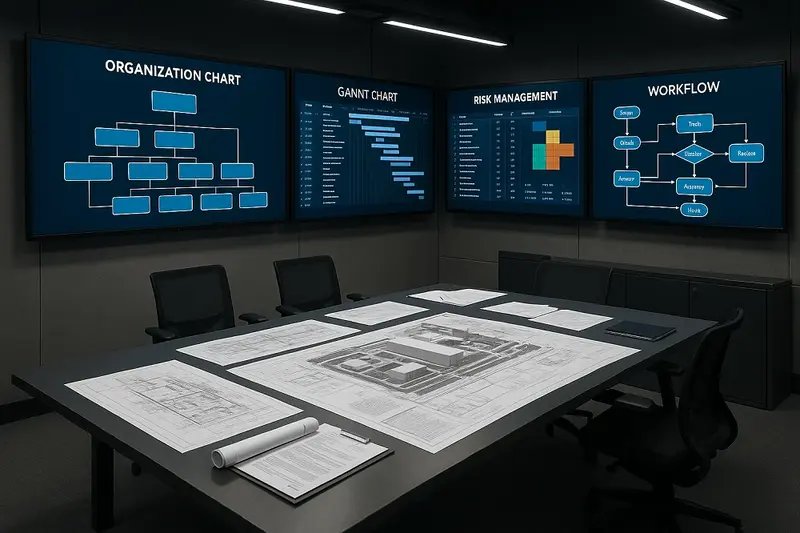
Large infrastructure, energy, or industrial projects need specialized organizational capabilities. We design those capabilities within your structure. This can involve creating dedicated project management offices (PMOs), establishing specialized technical units or implementing advanced risk management and stakeholder engagement functions tailored to the unique demands of mega projects.
We map, analyze and improve your delivery processes to shorten timelines, cut costs, and ensure consistent quality. This involves detailed process mapping, identifying non-value-added steps and implementing best practices in areas such as lean manufacturing, Six Sigma and agile development.
We restructure not just to fix problems but to enable planned expansion — creating space in your organization for the next stage of growth. This proactive approach to restructuring ensures that the organization is agile enough to capitalize on new opportunities and adapt to evolving market conditions, rather than merely reacting to challenges.
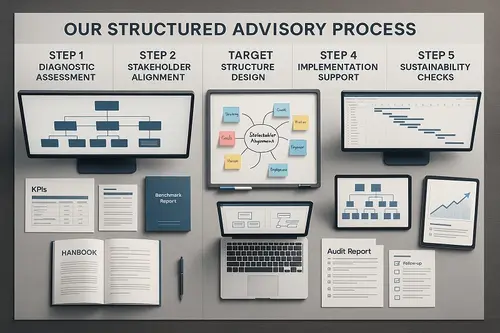
Full review of current organizational structure, processes and KPIs. Through Re Structural Advisory for Organizations, we identify hidden inefficiencies and structural misalignments. This phase involves data collection, stakeholder interviews, process observation and benchmarking to gain a comprehensive understanding of the current state and pinpoint areas for improvement.
Workshops, interviews and facilitated sessions bring leaders and managers into consensus on the vision and structural changes. Ensuring buy-in from key stakeholders is critical for successful implementation. This collaborative approach fosters a shared understanding of the challenges and the proposed solutions.
We create a new organizational framework that links strategy with on‑the‑ground execution. This involves designing new reporting lines, defining roles and responsibilities, optimizing workflows and developing key performance indicators (KPIs) to measure success. The new structure is tailored to support the organization’s strategic objectives.
We remain engaged during roll‑out, providing troubleshooting, coaching and performance monitoring. Our team works closely with your organization to manage the change process, address any challenges that arise and ensure the smooth adoption of the new structure and processes.
Post‑implementation reviews ensure the organization continues to perform at its optimized level. We conduct follow-up assessments to verify that the implemented changes are yielding the desired results and to identify any areas that may require further refinement or adjustment.
| Risk | Mitigation |
|---|---|
| Operational Disruption | Phased implementation and parallel system testing to avoid downtime. By rolling out changes in stages and running new systems alongside existing ones, we can identify and resolve issues before they impact critical operations. |
| Staff Resistance | Early communication, involvement of staff in design, and targeted training. Open and transparent communication about the reasons for change, involving employees in the redesign process, and providing comprehensive training can help to build acceptance and reduce resistance. |
| Compliance Gaps | Integrated compliance audits during the redesign phase. By incorporating compliance reviews throughout the restructuring process, we can ensure that the new structure and processes meet all relevant regulatory and industry standards. |
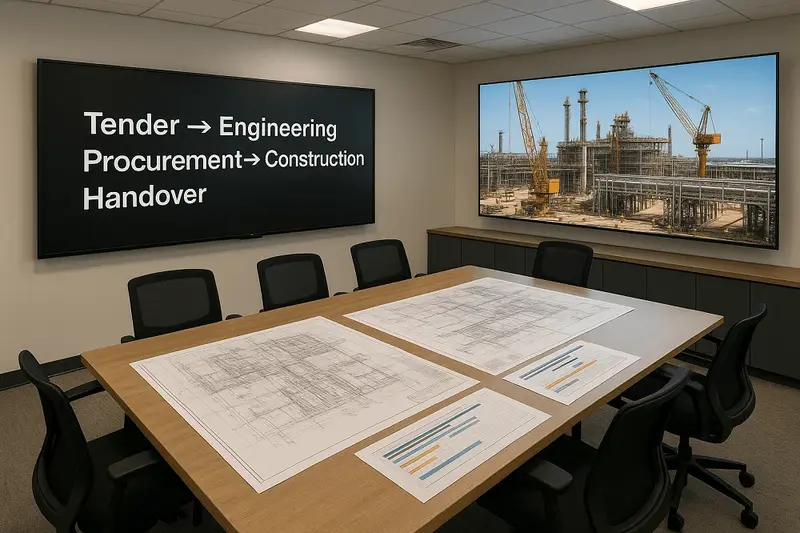
Energy EPC Firm: Improved delivery speed by 22% after process and structure redesign. This was achieved through streamlined communication channels, clearer project accountabilities and optimized resource allocation across project teams. This case reflects how Re Structural Advisory for Organizations can drive measurable efficiency gains in complex engineering projects.
Pharma‑to‑Energy Transition: Successfully restructured in under 8 months with zero major operational disruptions. This rapid and seamless transition was attributed to meticulous planning, effective change management and the strategic alignment of capabilities and processes.
Infrastructure Mega Project: Created a project‑based structure that cut communication delays by 35%. By establishing dedicated project teams with direct reporting lines and empowering project managers, decision-making became faster and more efficient, significantly reducing communication bottlenecks.
Contact us today to discuss how our Re‑Structural Advisory for Organizations and Projects can position your business for sustainable growth and competitive execution. Connect with us on LinkedIn or explore our educational content on YouTube.
The future of Re Structural Advisory for Organizations is rapidly evolving as industries navigate digital transformation, decarbonization and geopolitically driven supply chain changes. At OPM Group, we are actively investing in:
We believe that tomorrow’s most competitive organizations will be those that review and restructure proactively — not reactively. Embracing continuous improvement and adapting organizational structures to meet emerging challenges and opportunities will define resilient, high‑performing enterprises.
Submit a Request For This Service
At OPM Group, we deliver comprehensive PMC tailored to ensure the successful execution of complex industrial and infrastructure projects.Our expertise spans from the bidding stage through to project completion, providing robust support at every phase.
Stay updated with the latest security trends offers by subscribing to our newsletter.
Copyright © 2025 All Rights Reserved.