

At OPM Group, we understand that the Bid Stage is one of the most crucial phases in any project lifecycle. This stage sets the foundation for project success by defining the scope, expectations and responsibilities of all stakeholders. With decades of international experience, OPM Group ensures that every bid is technically sound, commercially viable and legally compliant. Our specialized Bid Stage services are designed to identify potential risks early, facilitate effective coordination and deliver competitive and compliant tenders that align with client objectives.
OPM Group operates with offices in Germany, serving Europe and the Middle East, and Canada, covering North America — delivering consistency and expertise across borders. Our deep understanding of regional procurement methodologies, from FIDIC-based international standards to specific national procurement laws, positions us as the ideal partner for complex global tenders.

The Bid Stage is far more than a procedural requirement; it is a high-stakes strategic process encompassing evaluation, alignment and rigorous risk management. During this phase, the owner/client’s requirements are translated into executable terms for contractors, consultants and suppliers. Any ambiguity, inconsistency or oversight in the documents issued or received can cascade into significant financial and schedule impacts during the subsequent Execution Phase.
In today’s highly competitive and regulated global markets, where variations in international compliance (e.g., ITAR, GDPR, local content rules) and client expectations differ dramatically, OPM Group delivers a structured, predictable and globally aligned approach to tender management. Our experts merge engineering insight, precision in project controls, and commercial intelligence to guarantee clarity, accuracy, and absolute transparency throughout the entire bid lifecycle, from Pre-Qualification (PQ) through to Final Submission and Clarification Rounds.
Achieving Scope Clarity: Ensuring that the scope of work, deliverables and exclusions are unequivocally defined.
Establishing Commercial Viability: Developing a pricing strategy that is competitive yet ensures acceptable profit margins and accurate cost forecasting.
Ensuring Contractual Fairness: Negotiating and accepting terms that balance risk appropriately among the contracting parties.
Demonstrating Capability: Presenting a compelling case that the bidding entity possesses the necessary technical acumen, resources and proven methodology to execute the project successfully.
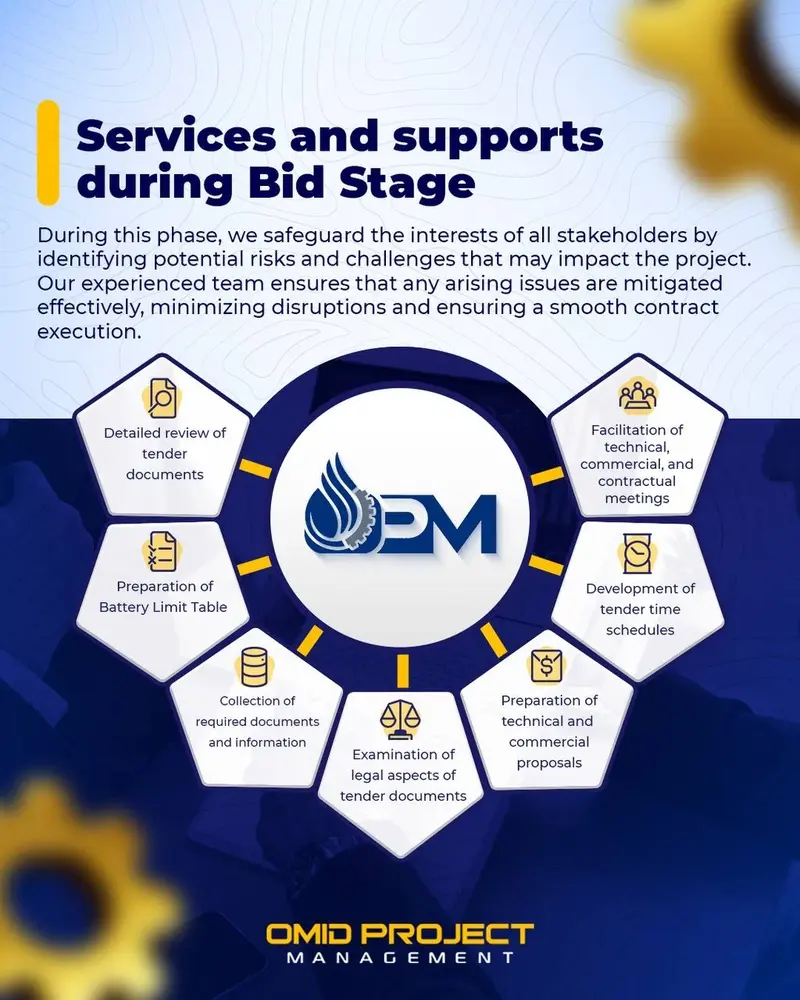
OPM Group’s service offering covers every dimension of the tendering process, ensuring no critical aspect is overlooked.

A foundational service, this involves a multi-layered forensic examination of all documents issued by the client:
Technical Specifications Review: Cross-referencing specified equipment standards, material requirements, and performance criteria against industry benchmarks and best practices. We identify if the requirements are overly prescriptive or, conversely, too vague.
Contractual Clause Assessment: Initial screening of the General and Particular Conditions of Contract (GCC/PCC). This includes a review of insurance requirements, liquidated damages clauses, payment terms and intellectual property rights assignment.
Commercial Terms Scrutiny: Verification of pricing mechanisms (e.g., lump sum, unit rate, cost-reimbursable), currency exposure, taxation implications and escalation/de-escalation formulas.
Our output includes a comprehensive Tender Query List (TQL) highlighting all potential areas of ambiguity requiring formal clarification from the client.
By including the Battery Limit Table (BLT) as a central activity within our Bid Stage services, OPM Group ensures that all Bid Stage interface responsibilities are systematically captured and clearly displayed for every stakeholder.
The Battery Limit Table (BLT) is a critical document for defining interfaces, often the source of major scope disputes. OPM Group develops a highly granular BLT that precisely delineates:
Civil/Structural Interfaces: Where the responsibility for foundations transfers from the owner to the contractor or between different specialist subcontractors.
MEP/Piping Interfaces: Defining demarcation points for tie-ins between vendor-supplied equipment skids and site-installed utility systems.
Information Exchange Gates: Establishing formal hand-off points for design documentation (e.g., IFC drawings, vendor data packs).
The BLT uses standardized icons and tabular formats, ensuring that accountability is traceable using a unique identifier for every defined interface zone.
Managing the inflow and outflow of data during a bid is a complex logistical task, especially across international consortia:
Subcontractor Prequalification Management: Overseeing the collection of financial statements, health & safety records (HSE), quality certifications (ISO) and corporate experience data from potential supply chain partners.
Data Repository Setup: Implementation of a secure, controlled Common Data Environment (CDE) tailored specifically for the bid phase, ensuring version control for all submitted drafts.
Response Matrix Generation: Creating a comprehensive matrix that tracks every single requirement listed in the client’s Invitation to Tender (ITT) against the document or signatory responsible for fulfilling that requirement, ensuring 100% compliance traceability.
This legal review is an integral part of our bid stage services, where OPM Group leverages deep expertise in contract law to help ensure our clients’ bids are both competitive and protected. By including bid stage legal scrutiny, we proactively address issues before contract award, reducing risk and building a stronger foundation for dispute-free execution.
Our dedicated legal review focuses on transforming potentially onerous contract language into manageable commercial exposure:
Warranty and Indemnity Review: Analyzing the duration and scope of warranties, pushing back on onerous perpetual liability clauses and ensuring limitations of liability are clearly defined and commercially acceptable.
Governing Law and Jurisdiction: Identifying the implications of proposed governing laws and arbitration forums (e.g., ICC, LCIA, local courts) and advising on jurisdiction risk exposure.
Force Majeure and Change Management Clauses: Ensuring that mechanisms for handling unforeseen events and scope changes are fair and do not unduly penalize the bidding party. We often model the financial impact of defined change scenarios.
As part of our bid stage services, OPM Group acts as the neutral facilitator and secretary for critical alignment meetings:
Technical Query Resolution Sessions: Structured meetings with engineering leads to resolve technical contradictions identified during the review process before submitting final queries to the client.
Pricing Strategy Workshops: Bringing together estimators, planners and commercial managers to agree upon markup structures, contingency allocation, and final proposed risk allowances.
Internal Gate Reviews: Implementing formal internal review gates (e.g., Concept Approval, Commercial Finalization Gate, Final Submission Gate) ensuring executive sign-off at predetermined stages.
We employ advanced critical path analysis tailored for the bidding phase:
Bid Milestone Definition: Establishing clear milestones for internal reviews, supplier quotations deadlines, internal management sign-offs and final client submission.
Resource Levelling Analysis: Assessing the required internal effort against available personnel, flagging potential bottlenecks in specialized areas (e.g., HAZOP review coordination, specific certification acquisition).
Inclusion of Client Clarification Periods: Factoring in realistic time buffers for receiving and incorporating responses from the client’s clarification rounds. The resulting schedule demonstrates high organizational maturity.

The final deliverable must be persuasive, compliant and professional:
Technical Proposal Drafting: Focusing on methodology, proposed execution plan, technology utilization, quality assurance protocols, and personnel qualifications. We emphasize how OPM Group’s approach minimizes risk factors identified in Section 6.
Commercial Proposal Structuring: Ensuring cost breakdown structures (CBS) align perfectly with the client’s required format. This includes developing robust cost models that accurately reflect assumptions regarding scope splits, provisional sums and anticipated inflation rates.
Value Engineering (VE) Integration: Where appropriate, incorporating pre-vetted VE options that demonstrate cost savings or performance enhancement opportunities without compromising core project objectives, thereby increasing the bid’s attractiveness.
OPM Group’s competitive advantage stems from our integrated, international operational structure and our commitment to proactive risk management, transitioning bids from mere compliance exercises into strategic positioning documents.
Our operations are governed by a unified project management framework, ensuring that the standards applied in our Germany office for a European infrastructure project are consistent with those used in our Canada office for a North American energy facility.
Cross-Discipline Synergy: Unlike firms where legal, commercial and engineering teams operate in silos, OPM Group enforces mandatory synergy workshops, meaning legal constraints immediately inform commercial pricing strategies and technical risks are quantified for scheduling.
Data-Driven Decision Making: We leverage historical bid performance data to refine risk factors and contingency planning.
We view ourselves as an extension of our client’s internal strategy team during the Bid Stage. Our engagement model is transparent, emphasizing frequent, scheduled updates and open dialogue regarding strategic decisions, such as whether to formally challenge a difficult contract clause or absorb a minor risk for tactical advantage.
Our focus on the Bid Stage is fundamentally driven by the desire to guarantee successful execution. We do not simply aim to win the contract; we aim to win a contract that is executable under manageable terms.
During the tender evaluation, we employ quantitative risk assessment techniques to translate qualitative findings into budgetary impacts:
Identification: Cataloguing all identified risks (e.g., scope ambiguity, late client decisions, specialized material lead times).
Analysis: Assigning probability (P_i) and financial impact (C_i) to each risk event (i).
Response Strategy: Determining mitigation, transfer, acceptance or avoidance for each risk.
Contingency Calculation: The required overall contingency fund (R_{Contingency}) is often estimated using Monte Carlo simulation based on the risk register data
By demanding the inclusion of this justified contingency within the final commercial proposal, we ensure the client bids with realistic expectations and the necessary financial buffers to weather inevitable unforeseen circumstances. This proactive approach dramatically reduces the likelihood of contractual claims surfacing during project execution.
The Bid Stage services defines the project’s destiny. A clear, compliant and competitive bid is the foundation of successful execution. OPM Group’s commitment to excellence ensures clients receive high-value proposals built upon thorough analysis, cross-functional coordination and strategic insight.
By choosing OPM Group, you gain a partner dedicated to precision, transparency and success — from Bid Stage to project handover. With our presence in Europe, the Middle East, and North America, we offer consistent quality no matter where your projects are located, ensuring that your competitive edge is maintained from the first submission document to the final signature.
Bid management is the organized process of planning, preparing, and submitting proposals in response to requests for proposals (RFPs) or tenders, aiming to create competitive bids that meet client requirements and increase the chances of winning contracts.
The bid management team typically includes a bid manager who coordinates the process, subject matter experts who provide technical input, writers who develop the proposal content, and senior leadership who offer strategic guidance and final approvals.
Effective bid management ensures proposals are clear, compelling, and aligned with client needs, improving win rates, reducing last-minute rushes, and focusing efforts on winnable opportunities to save time and resources.
The bid management process includes identifying relevant bids, preparing detailed proposals, submitting bids on time, evaluating submissions, negotiating contracts, and transitioning to project delivery upon contract award.
Submit a Request For This Service
At OPM Group, we deliver comprehensive PMC tailored to ensure the successful execution of complex industrial and infrastructure projects.Our expertise spans from the bidding stage through to project completion, providing robust support at every phase.
Stay updated with the latest security trends offers by subscribing to our newsletter.
Copyright © 2025 All Rights Reserved.