Industrial projects operate under strict timelines, complex engineering sequences, and procurement constraints. In this environment, Project Scheduling Tools help teams manage dependencies, track progress, and maintain control over critical milestones. A delay in equipment delivery or poor activity coordination can impact commissioning dates, contractor performance, and overall project costs. As a result, companies in EPC, infrastructure, oil and gas, and construction projects rely on professional scheduling platforms for better project control.
Modern Project Scheduling Software allows project teams to create logic-driven schedules, evaluate resource constraints, monitor progress, and forecast delays before they impact execution. Different tools serve different project environments. Some platforms focus on enterprise portfolio control, while others are designed for linear infrastructure projects or schedule diagnostics.
At OPM, professional scheduling platforms are used as part of project planning, monitoring, risk analysis, and reporting processes across industrial projects.

Oracle Primavera P6 is one of the most widely used solutions for large industrial and infrastructure projects. The software is designed for environments where thousands of activities, multiple contractors, and complex reporting requirements must be managed simultaneously.
Primavera P6 supports detailed scheduling logic, resource tracking, progress measurement, and portfolio-level visibility. Because of its scalability, the platform is commonly used in oil and gas, petrochemical, power plant, mining, and mega construction projects.
The software also supports integration with ERP systems, document management platforms, and cost control environments. This allows organizations to connect planning data with procurement, finance, and execution workflows.
Primavera P6 enables organizations to develop structured schedules across all project phases, from conceptual engineering to commissioning. Work Breakdown Structures, activity relationships, calendars, and constraints can be managed within a centralized system that supports detailed execution planning.
One of the software’s strengths is its ability to maintain schedule integrity in highly complex environments. Large industrial projects often involve overlapping engineering and construction activities across different contractors. Primavera allows planners to analyze these interfaces while maintaining traceable schedule logic.
The software also supports advanced reporting capabilities. Project controls teams can generate progress dashboards, float analysis reports, variance tracking, and critical path evaluations for different stakeholder groups.
Organizations managing multiple industrial projects require visibility beyond individual schedules. Primavera P6 supports portfolio management by allowing companies to monitor several projects within a single database environment.
This capability helps management teams compare project performance, evaluate resource allocation, and identify scheduling conflicts between parallel projects. Shared labor pools, procurement dependencies, and equipment utilization can be analyzed at portfolio level instead of isolated project views.
For companies operating large capital programs, this functionality improves strategic planning and supports better decision-making across the organization.
Microsoft Project is widely used in organizations that require structured scheduling capabilities without the complexity of enterprise-scale systems. The platform is suitable for engineering firms, medium-size construction projects, and internal project management environments.
Compared to larger enterprise platforms, Microsoft Project offers a more accessible interface while still supporting scheduling logic, resource management, baseline tracking, and progress reporting. As a widely adopted Project Scheduling Software, it provides a practical balance between functionality and usability. This balance makes it one of the Best Project Scheduling Tools for teams transitioning from manual planning methods.
One of the main strengths of Microsoft Project is its intuitive environment for project teams. Users can create logic‑based plans without complex configuration or technical setup. This allows planners to focus on defining activities, durations, and task relationships instead of managing system settings.
The platform offers clear visual planning through Gantt charts, task dependencies, and milestone tracking. These features make timelines easier to understand for engineers, managers, and other stakeholders. Communication about priorities and progress becomes more direct and structured.
Microsoft Project also supports resource assignments and workload visibility, helping managers identify potential overallocations early. For mid‑size projects, the software delivers structured planning and reliable reporting without adding unnecessary complexity to schedule maintenance.
Many organizations already rely on Microsoft platforms such as Excel, Teams, SharePoint, and Power BI. Microsoft Project integrates naturally with these tools, which simplifies reporting and collaboration workflows.
Project data can be transferred into dashboards, progress reports, or collaborative environments without requiring complex integrations. This is especially useful for organizations that prioritize operational simplicity and centralized communication.
The compatibility with existing Microsoft infrastructure also reduces implementation barriers compared to more specialized enterprise scheduling systems.

Asta Powerproject is commonly used in construction and engineering environments where visual schedule communication and site coordination are essential. The software is particularly effective for building projects, infrastructure developments, and contractor-driven execution environments.
Its interface focuses heavily on schedule visualization, short-term planning, and operational coordination between site teams.

Asta Powerproject provides detailed visual representations of project timelines, sequencing, and task relationships. Construction managers can quickly identify overlapping activities, workfront conflicts, and sequencing constraints directly within the schedule interface.
This visualization capability improves coordination between planning teams and field operations. Instead of relying only on tabular schedule data, project teams can interpret execution sequences more intuitively.
The software also supports short-term planning workflows, which are critical in dynamic construction environments where priorities change frequently.
Project Scheduling Tools for Collaboration in Construction Environments
Construction projects require continuous communication between contractors, subcontractors, consultants, and site management teams. Asta Powerproject supports collaborative planning processes by allowing multiple stakeholders to review and update scheduling information efficiently.
Site teams can track progress, evaluate look-ahead plans, and coordinate activities with greater transparency. This reduces conflicts between trades and improves execution sequencing during construction phases.
TILOS is a specialized Project Scheduling Software designed for linear infrastructure projects such as railways, highways, tunnels, and transmission corridors. Traditional Gantt-based schedules often struggle to represent location-based work progression effectively in these environments.
TILOS addresses this challenge through time-location planning methodologies that combine schedule data with physical project geography.
The software visualizes project progress across both time and location dimensions simultaneously. This allows planners to understand where activities occur and how crews move throughout the project corridor.
In linear projects, productivity depends heavily on work continuity and crew movement efficiency. TILOS helps planners reduce interruptions, optimize sequencing, and avoid workspace conflicts between parallel activities.
This approach provides significantly better visibility compared to conventional scheduling methods for geographically distributed projects.
Railway systems, highway developments, and pipeline installations involve repetitive activities distributed across long distances. TILOS allows planners to manage these repetitive workflows more effectively.
The software helps coordinate excavation, track installation, paving, welding, inspection, and commissioning activities while considering geographic constraints. This improves resource utilization and supports more realistic execution planning for infrastructure projects.
Safran Project is designed for industrial environments where schedule uncertainty and risk exposure require advanced forecasting capabilities. The software combines traditional scheduling functions with quantitative risk analysis techniques.
Industries such as offshore energy, defense, nuclear, and major capital programs frequently use Safran to evaluate schedule confidence levels and probabilistic completion forecasts.
Unlike conventional scheduling platforms, Safran integrates risk analysis directly into schedule management workflows. As an advanced Project Scheduling Software, it enables project teams to incorporate uncertainty into planning activities.
Project teams can model uncertainty within activity durations, productivity assumptions, and external risk factors. This integration allows planners to evaluate how risk events may influence milestone dates or overall project completion. Management teams gain more realistic visibility into schedule exposure instead of relying solely on deterministic forecasts.
Safran supports Monte Carlo simulations and scenario-based forecasting models. Rather than producing a single completion date, the software calculates probability ranges for schedule outcomes.
This capability helps organizations evaluate contingency requirements, acceleration strategies, and contractual exposure more accurately. In high-value industrial projects, probabilistic forecasting provides stronger decision support than traditional static schedules.
Deltek Acumen focuses on schedule quality analysis and validation rather than schedule creation alone. The platform is widely used in organizations that require compliance reviews, forensic schedule analysis, and independent schedule assessments.
It is often integrated with Primavera P6 and other Project Scheduling Tools to evaluate schedule reliability before project execution begins.
Acumen analyzes schedule logic, float integrity, missing relationships, excessive constraints, and unrealistic activity durations. These diagnostics help identify weaknesses that may reduce forecast reliability during execution.
Large industrial projects frequently contain hidden schedule issues that are difficult to detect manually. Acumen automates these evaluations and highlights areas requiring correction before baseline approval.
This improves confidence in project schedules and reduces the risk of inaccurate reporting later in the project lifecycle.
Many industrial projects must comply with scheduling standards defined by owners, governments, or international organizations. Deltek Acumen supports schedule validation against recognized industry frameworks and best practices.
Organizations can use the software to verify schedule quality before submission to clients or regulatory bodies. This is particularly valuable in contractual environments where schedule credibility directly affects project approvals and stakeholder confidence.
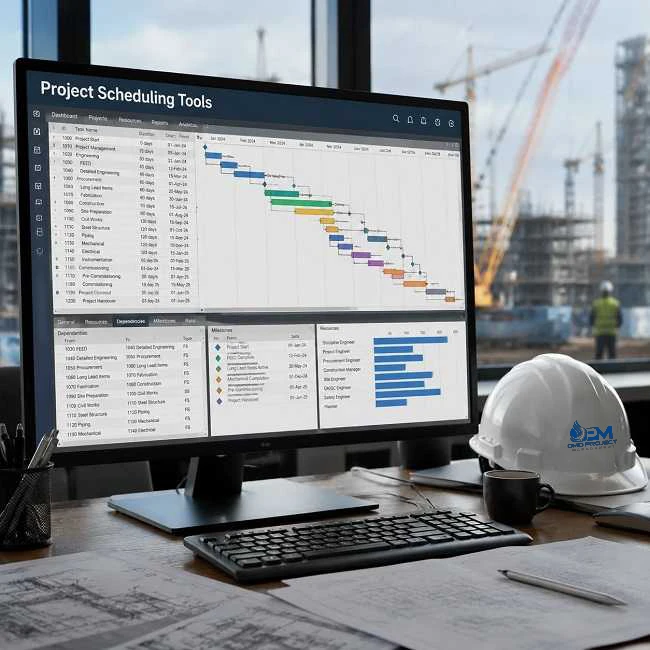
OPM applies professional Project Scheduling Software across industrial planning and project controls activities. The company works with different scheduling environments depending on project scale, infrastructure type, and contractual requirements.
This approach allows scheduling methodologies to align with actual project execution conditions rather than forcing a single planning structure across all projects.
Industrial projects require continuous schedule visibility to maintain control over cost, procurement, construction sequencing, and contractual milestones. By using advanced Project Scheduling Tools, OPM supports structured planning environments that improve reporting reliability and execution predictability.
The combination of scheduling expertise and specialized software helps project teams identify risks earlier, evaluate corrective actions faster, and maintain stronger control over project delivery performance.
At OPM Group, we deliver comprehensive PMC tailored to ensure the successful execution of complex industrial and infrastructure projects.Our expertise spans from the bidding stage through to project completion, providing robust support at every phase.
Stay updated with the latest security trends offers by subscribing to our newsletter.
Copyright © 2025 All Rights Reserved.