
Time Crashing in Project is a common response when a schedule begins to slip and deadlines remain fixed. However, it is not the only recovery option. Project teams often choose between accelerating critical activities by adding resources or reorganizing the existing schedule through rescheduling.
Time crashing reduces activity duration by increasing labor, equipment, or working shifts on critical path tasks. This approach shortens the overall timeline but raises direct costs. Rescheduling, in contrast, adjusts activity sequences and reallocates available resources without necessarily increasing the budget.
The choice between immediate acceleration and Rescheduling in Project becomes crucial when projects face delay risks. Selecting the right method helps protect deadlines while maintaining cost control and operational stability.

Not every delay requires acceleration. In many projects, the schedule can recover through adjustments in activity sequencing or better coordination between teams. However, when a milestone is tied to contractual obligations or financial penalties, simple schedule adjustments may not be enough. In these situations, Project Time Crashing may be considered to accelerate critical activities and protect the planned completion date.
Projects governed by fixed contractual milestones often require careful schedule control to avoid delays. Large infrastructure developments, energy facilities and industrial plants frequently include liquidated damages clauses that impose financial penalties for late completion.
When delays threaten these milestones, accelerating selected activities may be more economical than accepting penalties. For instance, deploying additional installation crews during the mechanical completion phase can recover lost schedule time and protect commissioning dates.
However, acceleration decisions should rely on measurable data. Project teams must evaluate how much time can realistically be recovered from each activity and whether the added resources will actually shorten the critical path.
Time Crashing in Project works best when the duration of an activity is directly influenced by resource availability. Construction works, field installations, fabrication processes and testing operations often fall into this category.
For example, doubling the workforce assigned to pipeline welding may significantly reduce installation time if sufficient workspace and supervision are available. Similarly, adding additional cranes or lifting equipment can accelerate structural assembly in large industrial facilities.
The key requirement is that the activity must remain technically manageable with increased resources. If overcrowding reduces productivity or creates safety risks, the expected schedule gain may not materialize.
Before implementing Time Crashing in Project, project managers typically verify several operational conditions. First, the targeted activities must lie on the critical path, ensuring that any reduction in duration will affect the project completion date.
Second, the organization must confirm that sufficient resources are available. Additional labor, equipment and supervisory capacity must be secured without disrupting other critical tasks.
Third, the project team should perform a cost–benefit evaluation. The additional cost of crashing should remain lower than the financial impact of delays or missed milestones. When these conditions are satisfied, crashing becomes a controlled and measurable schedule recovery method.

While acceleration receives significant attention in project management discussions, Rescheduling in Project planning often provides the most efficient solution for moderate delays. Instead of increasing costs, this approach focuses on optimizing how existing tasks and resources are organized.
One of the main advantages of rescheduling is that it can reduce schedule inefficiencies without increasing project expenditure. By analyzing activity relationships, planners may identify tasks that can safely overlap or run in parallel.
For instance, certain procurement activities may start before final design approval if technical risk remains manageable. Similarly, early preparation works can begin while detailed engineering continues.
These adjustments shorten the timeline through smarter sequencing rather than increased spending.
Resource shortages frequently cause delays in large projects. Specialized equipment, skilled labor, or inspection personnel may be available only for limited periods.
In these situations, Rescheduling in Project planning allows teams to reorganize activities so that available resources are used more efficiently. For example, moving certain engineering tasks forward while delaying others can prevent idle time for design teams.
Instead of adding more resources, the project schedule adapts to existing capacity, reducing pressure on procurement and staffing.
Not every delay threatens the final project completion date. Some schedule deviations occur on non‑critical activities, meaning they have float within the schedule.
In such cases, applying Time Crashing in Project would increase costs without improving the final delivery date. Rescheduling these activities within their available float is usually sufficient.
Careful schedule analysis helps determine whether acceleration is necessary or whether adjustments in sequencing can resolve the issue.
Both recovery methods aim to protect the planned completion date, but they influence cost, risk and execution in different ways. Selecting the right option requires a clear understanding of what each technique can realistically deliver under project constraints.
Project Time Crashing provides a direct way to shorten the schedule when deadlines cannot move. By allocating additional crews, equipment, or working shifts to critical path activities, teams can reduce overall project duration and avoid delay penalties. This approach is practical when the financial impact of late delivery exceeds the added cost of acceleration. However, crashing increases direct expenses and may reduce productivity if too many resources are deployed in limited work areas. It can also introduce safety and coordination challenges. For this reason, acceleration should focus only on activities that truly control the completion date and can respond effectively to added resources.
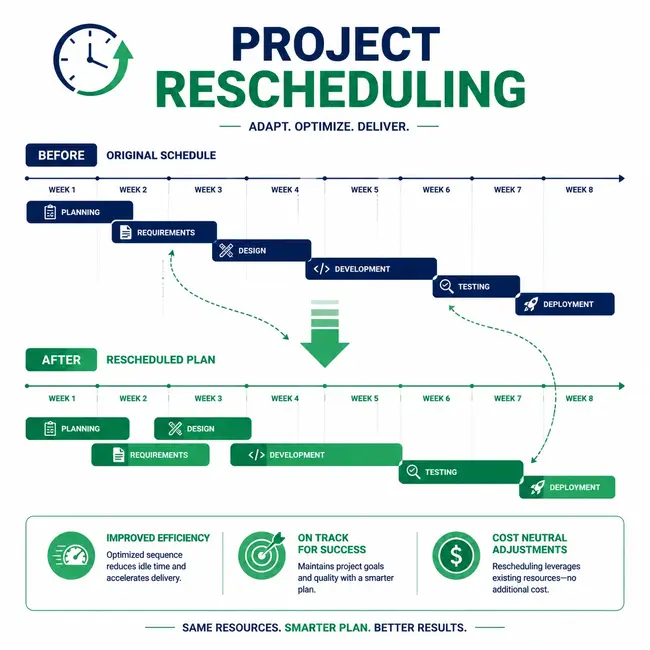
In contrast, Rescheduling in Project planning improves performance without necessarily increasing costs. By adjusting task sequences, overlapping compatible activities and reallocating available resources, teams can remove bottlenecks and recover time lost due to inefficient planning. This method supports better workload balance and protects budget stability. Its limitation lies in coordination complexity. Changes in logic may affect procurement timelines, subcontractor commitments, or inspection plans, and they require careful communication among stakeholders.
From a management perspective, the decision involves balancing schedule gain against financial exposure and operational risk. Acceleration delivers faster results but raises costs and execution pressure. Rescheduling preserves budget control but depends on flexible activity relationships. In many complex projects, a combination of both methods offers the most stable path to schedule recovery.
Schedule recovery strategies vary across project phases because activities and constraints change from one stage to another. During the engineering phase, delays often come from design revisions, incomplete data, or coordination gaps between disciplines. In many cases, teams can shorten the schedule by reorganizing workflows and running certain studies or design tasks in parallel.
Procurement may require both schedule adjustments and limited acceleration. Early supplier engagement, phased purchasing and revised delivery priorities can help reduce delay risks. During construction, however, activity durations depend heavily on manpower, equipment and site logistics. When critical milestones are threatened, Time Crashing in Project may be applied to accelerate installation, civil works, or commissioning activities through additional crews or extended work shifts.

Large industrial and infrastructure projects operate in environments where many technical and organizational factors interact. Delays often emerge from a combination of issues rather than a single isolated problem. Late design modifications, slow approval cycles, delayed equipment deliveries and coordination gaps between contractors are among the most common schedule challenges.
Another frequent issue is limited availability of specialized resources. Certain activities require experienced personnel, heavy equipment, or certified inspection teams that may not always be available when needed. These constraints can create bottlenecks that affect multiple downstream activities.
Because of these complexities, schedule control requires continuous monitoring of activity dependencies and resource allocation. Regular schedule reviews allow project teams to identify whether delays stem from inefficient sequencing, resource shortages, or external constraints, which helps determine the most practical corrective action.

Even experienced project teams sometimes misapply schedule recovery techniques. These mistakes usually occur when decisions are made without detailed schedule analysis.
One frequent mistake is applying Time Crashing in Project to activities that are not on the critical path. Although these activities may finish earlier, the overall project completion date remains unchanged.
Effective crashing requires precise identification of critical path tasks.
Rescheduling may appear simple in theory, but ignoring resource constraints can create new conflicts. If multiple activities require the same equipment or specialists at the same time, schedule adjustments may introduce additional delays.
Some recovery actions solve immediate delays but create future coordination problems. Sustainable schedule control requires evaluating how each adjustment affects the entire project timeline.
An effective recovery plan starts with a precise understanding of where the delay actually occurs. OPM begins by examining the project schedule to identify the critical path and the activities that directly influence the final completion date. This analysis also reviews the underlying causes of delay, such as late engineering deliverables, procurement bottlenecks, or coordination conflicts between contractors. By distinguishing between critical and non‑critical activities, the team can focus corrective actions where they produce real schedule improvement. When delays affect tasks on the critical path, options such as Time Crashing in Project may be considered to accelerate progress and protect key milestones.
After identifying the delay drivers, OPM evaluates the operational feasibility of different recovery options. This assessment examines workforce availability, equipment capacity, subcontractor readiness and site logistics. The financial implications of schedule changes are also reviewed to determine whether acceleration measures remain economically reasonable. In parallel, the team analyzes operational risks that may arise from increased work intensity, such as productivity loss, safety concerns, or coordination difficulties. Through this balanced evaluation, project managers can understand whether Project Time Crashing is practical or whether adjustments in sequencing and resource allocation would achieve better results with lower risk.
Once schedule drivers, resource capacity and cost implications are understood, OPM determines the most reliable recovery strategy for the project environment. In some situations, reorganizing task sequences or redistributing available resources provides enough flexibility to restore progress. In others, strict contractual deadlines or critical path delays may require targeted acceleration. The decision therefore considers technical feasibility, resource constraints and financial exposure. When appropriate, Rescheduling in Project planning can stabilize workflow and remove bottlenecks without increasing costs. In more time‑sensitive conditions, acceleration measures are applied selectively to regain schedule control while maintaining operational stability.

Industrial and infrastructure projects require schedule control methods that are technically sound and practical in real operating conditions. OPM Group provides structured project management consultancy that helps project teams manage schedule risks from early planning to final delivery. By combining schedule analysis with practical site experience, OPM supports teams in maintaining progress and preventing delays that can affect major milestones.
OPM delivers Professional PMC services starting from the bidding stage and continuing through engineering, procurement, construction and commissioning. This continuous involvement allows potential schedule risks to be identified early and managed consistently throughout the project lifecycle. Early planning support helps align project timelines with technical requirements, contractor capabilities, and procurement schedules.
Schedule recovery decisions often require balancing time, cost and available resources. OPM applies structured analysis methods to identify the most practical recovery strategy for each situation. When critical activities threaten the project deadline, Time Crashing in Project may be recommended to accelerate progress. In other cases, adjustments in task sequencing or resource allocation can restore schedule performance without increasing costs.
OPM focuses on practical implementation rather than relying only on theoretical planning tools. Schedule strategies are developed based on real site conditions, contractor capacity and procurement timelines. This approach helps ensure that corrective actions lead to measurable improvements in project performance while maintaining operational stability.
Projects facing schedule pressure often benefit from independent evaluation and structured recovery planning. With experience in complex industrial and infrastructure developments, OPM supports project teams in selecting and implementing the most effective schedule optimization strategies.
At OPM Group, we deliver comprehensive PMC tailored to ensure the successful execution of complex industrial and infrastructure projects.Our expertise spans from the bidding stage through to project completion, providing robust support at every phase.
Stay updated with the latest security trends offers by subscribing to our newsletter.
Copyright © 2025 All Rights Reserved.